Shift Differential Rate: How Much Extra You’re Owed for Nights, Weekends, and Holidays
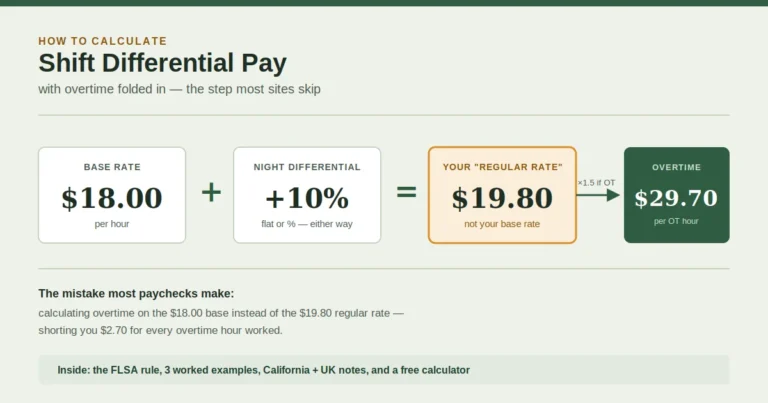
Your pay stub shows a small bump for the night shift you worked — but is it the right amount, or does your employer even owe you one at all? Shift differential pay isn’t required by federal law, but once your employer starts paying it, that money has to be folded into your overtime rate, and a lot of paychecks get that part wrong.
By the end of this, you’ll know what a typical night or weekend differential looks like, whether your employer legally owes you one, and how to check your own numbers with the same regular-rate math the Department of Labor uses.
Already know your rate? The shift differential calculator below does the math for you.
What Is Shift Differential Pay, and How Is It Different From Overtime?
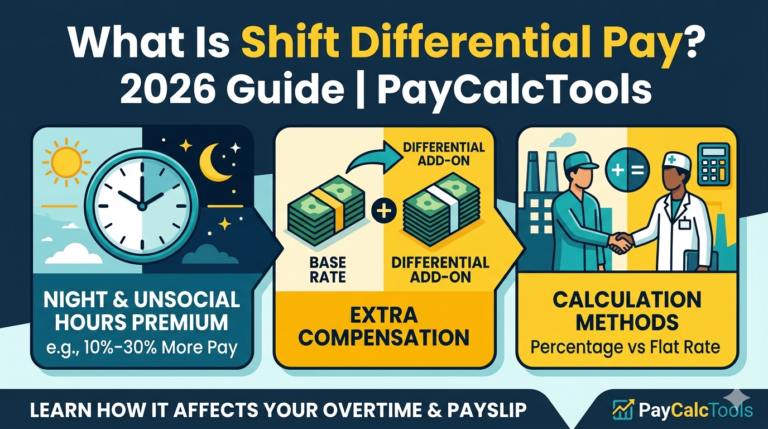
Shift differential is extra money — a flat dollar amount per hour or a percentage on top of your base rate — that an employer chooses to pay for working a shift most people don’t want: nights, evenings, weekends, or holidays. It isn’t overtime, which is about hours worked, and it isn’t hazard pay, which is about what the job involves.
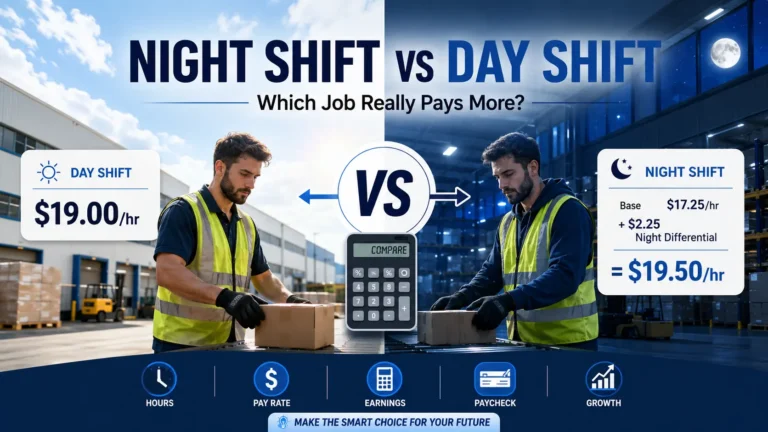
A warehouse worker earning $19.00/hr with a $1.75/hr night differential makes $20.75/hr for every hour on that shift — nothing more complicated than that. What trips people up is what happens next: once a differential exists and you work overtime, federal law says it has to be blended into your overtime rate too.
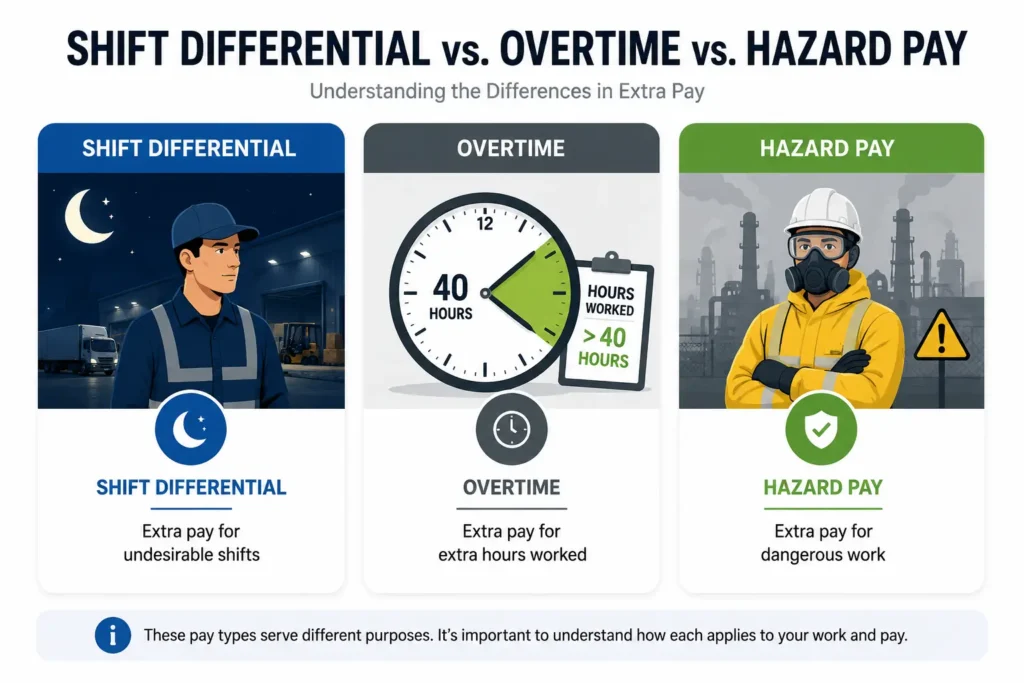
There’s no single answer to what time does shift differential start, since employers set their own windows. Most define “night” or “graveyard shift” differential as roughly 10pm to 6am and “weekend” as any hours on Saturday or Sunday — policy choices, not legal boundaries, so the only way to know your employer’s exact cutoff is your handbook.
If you’d rather skip the manual math, check your exact night or weekend differential pay — the calculator applies these same rates to your base pay instantly.
| Hours type | Hours | Rate | Pay |
|---|
Is Shift Differential Pay Required by Law?
No. Federal law under the FLSA does not require private-sector employers to pay a shift differential for nights, weekends, or holidays, and most states follow the federal baseline. The main exceptions are:
- federal Wage System employees, who get a mandated 7.5–10% differential under 5 CFR Part 532
- Rhode Island, which requires time-and-a-half for Sunday and holiday work by statute.
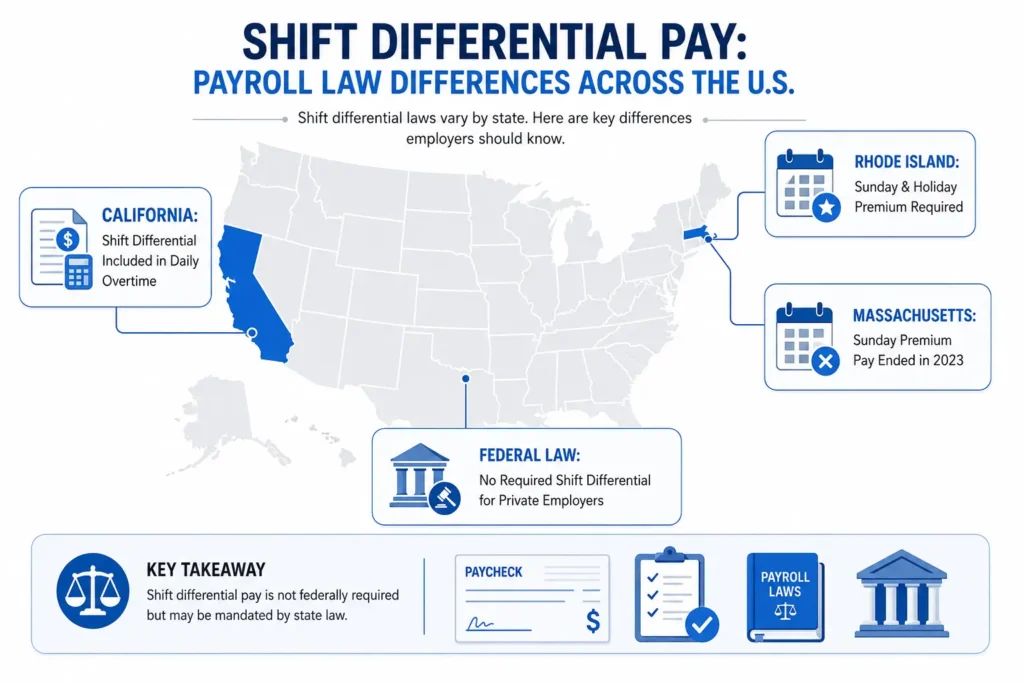
It’s entirely a matter of employer policy, contract, or collective bargaining agreement outside of those two exceptions.
That said, Rhode Island’s rule deserves its own note: R.I. Gen. Laws § 5-23-2 requires time-and-a-half for Sunday and state-holiday work independent of the standard 40-hour overtime threshold.
California doesn’t require a differential either — but once one is offered, it has to feed into the state’s stricter overtime calculation, which kicks in after 8 hours in a single workday, not just after 40 in a week.
Massachusetts is worth flagging on its own: older articles still describe a retail Sunday and holiday premium pay requirement there, but that rule was fully phased out as of January 1, 2023.
In the US, one narrow federal exception aside, this is the whole picture. Outside the US: in the UK, there’s likewise no statutory requirement for a night, weekend, or “unsocial hours” premium. The only hard floor is the National Minimum Wage and National Living Wage — currently £12.71/hour for workers 21 and over as of April 2026 — and any shift premium sits on top of that floor.
Shift Differential and Overtime Law: What the FLSA and UK Rules Actually Require
In the US: FLSA and the Regular Rate of Pay
The FLSA doesn’t require a shift differential — it only kicks in once your employer decides to pay one, and that’s where 29 CFR §§ 778.207 and 778.109 come in. The trigger is any week a non-exempt employee works more than 40 hours; once crossed, the employer must calculate a “regular rate of pay” that includes the differential, not just the base hourly rate, and pay 1.5 times that blended rate for overtime hours. This only applies if you’re non-exempt. Salaried employees who clear $684/week ($35,568/year) and meet the duties tests are exempt from overtime altogether, so none of this blending math applies to them. Federal Wage System employees are the one carve-out with a mandated differential: 7.5% evenings, 10% nights, under 5 CFR Part 532. The Department of Labor’s Fact Sheet #54 walks through this exact regular-rate calculation using healthcare wage examples.
In the UK: Minimum Wage and Working Time Rules
The National Minimum Wage Act 1998 and National Minimum Wage Regulations 2015 set the wage floor employers must clear on average, but don’t require any shift premium on top of it. The Working Time Regulations 1998 cap night workers — anyone regularly working three or more hours between 11pm and 6am — at an average 8-hour shift over a 17-week reference period, with no opt-out for that limit. Once a shift allowance is written into a contract, or established through consistent practice, withholding it can count as an unlawful deduction of wages under the Employment Rights Act 1996.
The figures above are based on current federal law. State laws may provide additional protections. For compliance decisions, consult a qualified payroll professional or check the official Department of Labor / HMRC guidance directly.
How the Numbers Work: 3 Real Shift Differential Examples
Here’s how the math plays out for three common situations — a straight night shift with no overtime, a blended overtime week, and a holiday shift where an old rule no longer applies.
| Example | Base Rate | Differential | Hours Worked | Result |
|---|---|---|---|---|
| 1. Warehouse worker, Ohio Flat night differential, no overtime | $19.00/hr | $1.75/hr flat (night) | 32, all nights | $664.00 ($56.00 differential) |
| 2. Nurse, Pennsylvania Blended overtime, day + evening | $22.00/hr | $1.00/hr (evening) | 48 (24 day, 24 evening, 8 OT) | $1,170.00 (not $1,168) |
| 3. Retail worker, Massachusetts Holiday shift, no premium applies | $18.00/hr | None (repealed 2023) | 6 (holiday), 34 total that week | $108.00 (straight time) |
Example 1: Flat-Rate Night Differential, No Overtime
Calculation: Effective hourly rate is $19.00 plus $1.75, which comes to $20.75/hr. Multiply that by 32 hours worked.
What this means: If a pay stub shows less than $664 for 32 straight-time night hours at this rate, it’s worth checking the differential line item.
Example 2: Blended Overtime Rate for a Nurse Working Day and Evening Shifts
Calculation: Straight-time earnings are (24 × $22.00) plus (24 × $23.00), totaling $1,080. Divide by 48 hours for a regular rate of $22.50/hr. Overtime premium owed is 8 hours × half of $22.50, or $90.00 — for a total of $1,170.00, not the $1,168 you’d get calculating overtime on the $22.00 base rate alone, the version DOL Fact Sheet #54 flags as a violation.
What this means: The shortfall looks small per week, but across a full staff over a year, it adds up to real back-pay exposure.
Example 3: Massachusetts Holiday Shift — Why There’s No Extra Sunday Pay Anymore
Calculation: Massachusetts eliminated its retail Sunday and holiday premium pay requirement as of January 1, 2023, and weekly hours are under 40, so no federal overtime applies either. Pay for the shift is simply 6 × $18.00.
What this means: Checking the current handbook — not older articles — is the only reliable way to know if a holiday premium still applies. Readers outside Massachusetts should check their own state’s rules above.
For your own numbers, the shift differential calculator handles this calculation for any combination of base rate, differential, and hours — including the overtime blending most payroll systems get wrong. Run your own overtime-and-differential numbers through the calculator
Common Questions About Shift Differential Pay
Many employees assume that working nights or weekends automatically comes with legally required extra pay. It doesn’t — at the federal level in both the US and the UK, a shift differential is discretionary unless it’s written into a contract, a collective bargaining agreement, or, for a narrow group of federal Wage System employees, a specific government pay schedule.
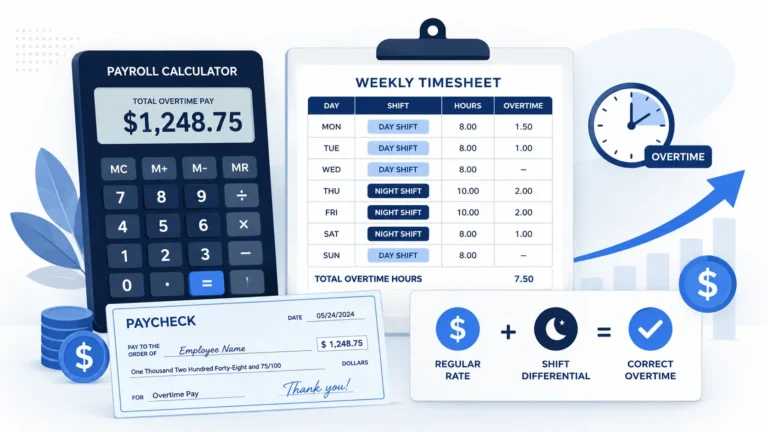
A related assumption is that shift differential and overtime are two separate line items that don’t touch each other. Under US federal law, that’s backwards: the differential raises your regular rate of pay, which raises your overtime rate for that week. Skipping this step is one of the most common wage-and-hour mistakes employers make, and it’s exactly what DOL Fact Sheet #54 was written to correct.
Finally, there’s no single “standard” night shift differential percentage across every industry. Private-sector rates typically run 5–15% of base pay or $0.50–$3.00/hr flat, while healthcare and manufacturing often run higher — 15–25% or $3–$6/hr — because those shifts are harder to staff. Whether it’s called a night differential or a graveyard shift pay differential usually just depends on the employer’s handbook — the legal treatment is identical either way.
Frequently Asked Questions
What is shift differential pay?
Shift differential pay is extra money — a flat amount or a percentage of your base rate — that an employer chooses to pay for working a less desirable shift, such as nights, evenings, weekends, or holidays. It’s separate from overtime, which depends on hours worked, and from hazard pay, which depends on the work itself. A common example is $1.75/hr on top of a $19.00 base rate for a night shift.
Is shift differential pay required by law?
No — federal law doesn’t require private-sector employers to pay a shift differential for nights, weekends, or holidays, and most states don’t require one either. The main exceptions are federal Wage System employees, who get a mandated differential under 5 CFR Part 532, and Rhode Island, which requires time-and-a-half for Sunday and holiday work by statute. Outside of those, it’s a matter of employer policy or contract.
Does shift differential count toward overtime pay?
Yes. Under 29 CFR § 778.207, once an employer pays a shift differential, it has to be included in the “regular rate of pay” used to calculate overtime for that week. An employer can’t calculate the 1.5x overtime premium on the base rate alone and treat the differential as a separate bonus — you can run this exact calculation for your own base rate and hours using the shift differential calculator.
Do Massachusetts retail workers still get Sunday premium pay?
No. Massachusetts fully phased out its retail Sunday and holiday premium pay requirement as of January 1, 2023. Retail employees there are now subject to the same standard 40-hour weekly overtime rule as workers in any other industry, regardless of which day the hours fall on. If your handbook still promises Sunday premium pay, that’s now a matter of company policy, not state law.
The math that matters most here isn’t the differential itself — it’s what happens to your overtime rate once that differential exists, the exact step DOL Fact Sheet #54 was written to correct. If your pay stub shows overtime calculated on your base rate alone in a week you also worked a differential, that’s worth checking.
The shift differential calculator runs this same regular-rate math for your base rate, differential type, and hours, including states with stricter triggers like California. For the standard rules this builds on, see our guide on how overtime pay is calculated, and for broader paycheck questions, our hourly employee pay rights post.