How to Catch a Shift Differential Paycheck Error Before It Costs You
If you worked a night or weekend shift with overtime this pay period, there’s a good chance your employer calculated that overtime wrong — not out of malice, but because most payroll systems default to your base rate instead of the blended rate the law actually requires. This is a shift differential paycheck error, and it’s one of the most common mistakes hiding on an otherwise normal-looking pay stub. By the end of this, you’ll know exactly how your overtime should be calculated when a differential is involved, and how to check your own numbers against it. The math isn’t complicated. What trips people up is not knowing the blended-rate rule exists in the first place.
What Shift Differential Is (and Isn’t) Legally Required to Be
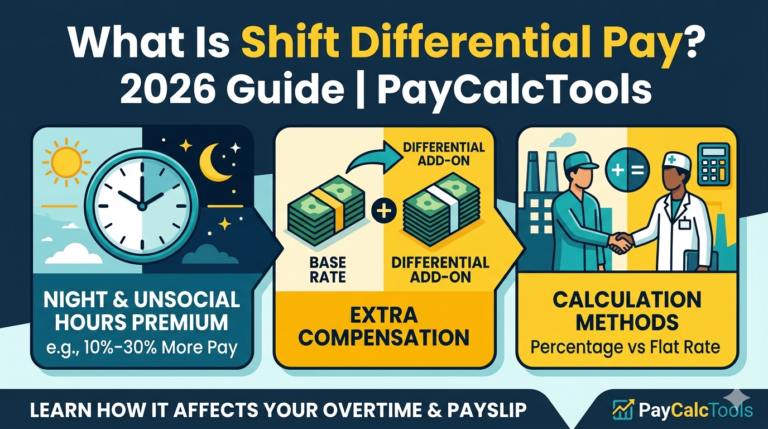
Shift differential is extra pay for hours most people don’t want to work — nights, weekends, holidays, rotating shifts. It’s usually a flat amount per hour or a percentage added to your base rate. Here’s what most pay-information sites skip: it isn’t a government benefit, and no federal law requires a private employer to offer it. The decision belongs to the employer — how much to pay, and under what conditions — unless a union contract, state law, or, for federal workers, a specific federal regulation says otherwise.
This applies most directly to hourly, non-exempt workers (employees legally entitled to overtime), since differential pay only changes your overtime math once you’re entitled to overtime in the first place. Take a nursing assistant earning $19.50 an hour with a $2.00 night differential: on a night shift, the rate her overtime should actually be built from is $21.50, not $19.50. Most workers never learn that second part — which is exactly where paycheck errors start.
Is Shift Differential Pay Required by Law?
No. Under the Fair Labor Standards Act, private employers aren’t required to pay shift differential for nights, weekends, or holidays — it’s entirely discretionary unless a union contract, state law, or company policy requires it. Federal Wage System government employees (covered by the federal government’s blue-collar, wage-grade pay system) are the exception, receiving a statutory night differential under federal regulation.
The FLSA doesn’t single out shift differential by name because it doesn’t need to — the statute governs minimum wage and overtime, not premium pay for unpopular hours. That leaves the decision to the employer, whether it’s written into an offer letter, an employee handbook, or a collective bargaining agreement.
The one major exception sits inside the federal government. Federal Wage System employees get a statutory night shift differential: 7.5% of basic pay when most of a shift falls between 3 p.m. and midnight, and 10% when most of it falls between 11 p.m. and 8 a.m. State law can move the baseline too — Texas has no differential-specific statute, while California’s daily overtime rule changes what happens once a differential is offered, covered further below.
The Rule Most Employers Get Wrong: Shift Differential and the “Regular Rate”
Once an employer pays shift differential, it stops being optional extra money and becomes part of the number the law uses to calculate overtime. This comes from the FLSA’s overtime provisions and the Department of Labor’s regulations on the “regular rate of pay” — specifically 29 CFR 778.207 and DOL Fact Sheet #56A.
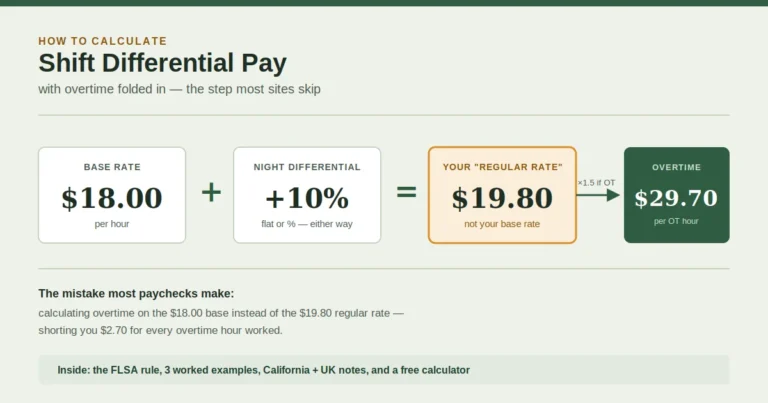
If you’re a non-exempt hourly worker, your overtime is 1.5 times your regular rate for every hour worked past 40 in a single workweek. (California and a few other states also require daily overtime — see the state-by-state section below.) The regular rate isn’t your base hourly wage — it’s your total straight-time pay for the week, including shift differential, divided by total hours worked. Wondering why does my shift differential pay vary from week to week? It’s because this number gets recalculated every workweek, since your total pay and total hours both change. Employers can’t get around this by agreement with the employee, and the regular rate can never fall below the applicable minimum wage — $7.25 an hour federally, or higher where state or local law sets a higher floor.
This covers non-exempt hourly employees under the FLSA — most shift workers. Employees classified as exempt (salaried at $684 a week or more, in an executive, administrative, or professional role) aren’t entitled to overtime regardless of any differential they receive.
The figures above are based on current federal law. State laws may provide additional protections. For compliance decisions, consult a qualified payroll professional or check the official Department of Labor’s overtime guidance directly.
How to Read Your Pay Stub With Shift Differential
Here’s how to check your own numbers using nothing but a recent pay stub and a calculator.
- Find your base rate and your differential separately. Most pay stubs list them as two line items — base hourly pay and a differential, shift premium, or night-pay line. If yours doesn’t separate them, ask payroll for a breakdown.
- Add them together to get your blended rate for differential hours. Base rate plus differential — that’s the number your overtime should be built from, not your base rate alone.
- Check how your overtime hours were actually paid. Multiply your blended rate by 1.5, then compare that to what you were paid per overtime hour. If your OT rate matches 1.5× your base rate instead of 1.5× the blended rate, that’s the error.
- If you worked a mixed week — some hours with differential, some without — use the weighted-average version. Add up all your straight-time pay for the week, divide by total hours worked, and that’s your true regular rate. Overtime should be 1.5× that number.
- Check your state’s overtime rules. In states with daily overtime, like California, hours over 8 in a single day may owe overtime even in a week under 40 hours total.
- Run the numbers through a calculator to confirm your math, especially in a mixed week where the weighted-average calculation gets tedious by hand.
Shift Differential Overtime: 3 Worked Examples
Example 1: Flat-Rate Night Differential, Federal Overtime Only
Scenario: A CNA in Ohio earns a base rate plus a flat night-shift differential and works overtime in a week with no state daily-overtime rule involved.
Starting numbers:
- Base rate: $19.50/hour
- Night differential: +$2.00/hour
- Hours worked: 46, all on nights
Calculation: Add the differential to the base rate for a blended rate of $21.50 an hour. Pay all 46 hours at that rate: 46 × $21.50 = $989.00. Add the overtime premium for the 6 hours over 40 — half the blended rate times those hours: $21.50 × 0.5 × 6 = $64.50.
Correct total pay: $1,053.50
What this means: A common employer error pays the differential as a flat add-on and calculates overtime at 1.5× the base rate alone, landing at $1,047.50 — a $6.00 shortfall that looks like a rounding error but recurs every week the pattern continues.
Run your own shift and overtime numbers through the shift differential calculator — once you’ve seen the blended rate change the math above, it’s worth checking your own week the same way.
Example 2: Percentage Weekend Differential With California Daily Overtime
Scenario: A California warehouse worker earns a percentage-based weekend differential and works one long Saturday shift.
Starting numbers:
- Base rate: $24.00/hour
- Weekend differential: +15%
- Hours worked: 10, all Saturday
Calculation: The weekend blended rate is $24.00 × 1.15 = $27.60. Under California’s daily overtime rule, hours 1–8 are straight time and hours 9–10 get 1.5× the regular rate. Straight-time pay for the first 8 hours: 8 × $27.60 = $220.80. Overtime pay for the last 2 hours: 2 × ($27.60 × 1.5) = $82.80.
Correct total for the day: $303.60
What this means: Employers sometimes apply the weekend differential only to the first 8 hours, then pay the last 2 at 1.5× the base rate alone — landing at $292.80, a $10.80 shortfall for one shift. Note: this example uses California’s daily overtime rule; federal-only math would never catch this, since federal law doesn’t trigger overtime until 40 hours in a week.
Example 3: Stacked Differentials Across a Mixed Week
Scenario: A New York nurse earns both a night differential and a weekend differential, which stack on a Saturday-night shift within a week that also includes ordinary day shifts and overtime.
Starting numbers:
- Base rate: $34.00/hour
- Night differential: +12% (about $4.08/hour)
- Weekend differential: +$3.00/hour flat, stacking with the night differential
- Stacked hours: 12 (Saturday night)
- Ordinary hours: 36 (day shifts, base rate)
- Total hours: 48 (8 overtime)
Calculation: The stacked rate for the 12 qualifying hours is $34.00 + $4.08 + $3.00 = $41.08. Pay for those hours: 12 × $41.08 = $492.96. Pay for the remaining 36 base-rate hours: 36 × $34.00 = $1,224.00. Total straight-time pay for the week: $1,716.96. Divide by all 48 hours worked for the true weekly regular rate: $35.77. The overtime premium is half that rate times the 8 overtime hours: $35.77 × 0.5 × 8 = $143.08.
Correct total weekly pay: $1,860.04
What this means: Many payroll systems apply the differential-only rate to all 8 overtime hours, assuming the overtime happened during the differential shift, instead of averaging across every hour worked that week. Any mixed week needs this full weighted-average method — there’s no shortcut based on which shift you were on at hour 41.
For your own numbers — including states with different overtime triggers — the shift differential calculator handles this calculation for any combination of hours, rates, and differentials.
State and Federal Variations: Where the Math Changes
California is the state where this topic matters most. California Labor Code §510 requires daily overtime — 1.5× after 8 hours in a single day, 2× after 12 — on top of the standard 40-hour weekly trigger, and shift differentials are included in the regular rate used for both. The 2026 statewide minimum wage is $16.90 an hour, and the exempt salary threshold is $70,304 a year. You can check current thresholds directly on California’s Department of Industrial Relations site.
Federal Wage System employees get the statutory 7.5%/10% night differential described earlier — a benefit most private-sector guides never mention, since it only applies to government wage-grade jobs.
New York has no shift-differential-specific statute; it follows the federal regular-rate framework. Workers there sometimes confuse differential pay with “spread of hours” pay — an unrelated extra hour of pay when a workday spans more than 10 hours.
In the UK, there’s no general legal right to extra pay for nights or weekends — it comes from your contract, not a statute. The one concrete exception is the NHS, where the Agenda for Change agreement sets roughly a 30% enhancement for weeknights and Saturdays, and roughly 60% for Sundays and public holidays.
Shift Differential Red Flags: Signs Your Paycheck Is Wrong
Run your last pay stub against this list — these are the specific signs your overtime math skipped the blended-rate step.
- Your overtime rate, divided by your base rate, comes out to exactly 1.5, with no trace of your differential anywhere in the math.
- Your differential is paid as a flat line item on every hour, including overtime hours, instead of being folded into the rate those hours were paid at.
- You worked a mixed week — some hours with differential, some without — and your overtime rate looks identical to a week where you worked differential hours the entire time.
- You’re in a state with daily overtime, like California, and a long single shift with a differential didn’t trigger any daily OT at all.
- Your pay stub doesn’t show a “regular rate” or blended rate anywhere — only a base rate and a separate differential line.
If any of these match what you’re seeing, plug your exact hours, base rate, and differential into the calculator and compare the result line by line against your stub.
Check What You Should Have Been Paid →
What to Do If You Find a Shift Differential Paycheck Error
Start with payroll, not a lawyer. Most shift-differential miscalculations come from a payroll system default, not an intentional shortchange, and plenty get corrected the same pay period once someone flags the specific week and hours involved.
If payroll doesn’t fix it, take it to HR in writing — the hours, the rates, and the correct blended-rate calculation laid out next to what you were actually paid.
If it’s still unresolved, you can file a complaint with your state labor department or the federal Wage and Hour Division, which enforces the FLSA. Keep your own pay stubs; employers are required to retain wage records, but you shouldn’t have to rely on that alone.
Frequently Asked Questions
Can I Get Back Pay If My Overtime Was Miscalculated?
Yes. Under the FLSA, you can generally recover unpaid overtime going back two years, or three years if the miscalculation was willful. You can pursue this directly with your employer, file a complaint with the Wage and Hour Division, or in some cases file a private lawsuit; state law may allow a longer look-back period.
Does Shift Differential Count Toward Overtime Pay?
Yes — once you’re paid a shift differential, it has to be included in your “regular rate of pay,” the number your overtime rate is built from, so employers can’t calculate overtime on your base rate alone and pay the differential separately. That’s the most common shift differential paycheck error on real pay stubs. You can run this calculation for your specific rate and hours using the shift differential calculator, which handles this automatically.
What Is the “Regular Rate of Pay” and Why Does It Matter for Shift Workers?
The regular rate is your total straight-time pay for a workweek — base wages plus shift differential and most other pay — divided by total hours worked that week. It matters because overtime is calculated on this blended number, not your base hourly rate, and it has to be recalculated every workweek since your hours and pay change.
Does California Require Shift Differential to Be Included in Daily Overtime, Not Just Weekly Overtime?
Yes. California Labor Code §510 requires daily overtime — 1.5× after 8 hours in a day, 2× after 12 — and shift differentials are included in the regular rate used to calculate it, on top of the standard weekly trigger, which means a single long differential shift can owe daily overtime even in a week under 40 hours total.
Does Shift Differential Still Apply If I Only Work Part of a Qualifying Shift?
It depends on your employer’s written policy, since federal law sets no minimum-hours rule for differential eligibility. Many employers require a set portion of the shift — often a majority of it — inside the qualifying window before differential applies; others pro-rate it by the hour. Check your employee handbook or ask payroll directly, since this is one of the few pieces of differential pay that’s entirely employer-defined.
The Bottom Line
A shift differential isn’t extra money sitting outside your paycheck’s math — it’s part of it. If Example 3 above looked like your last mixed week, some differential hours and some without, plus overtime, that’s the calculation worth double-checking first.
If you need your exact number, the shift differential calculator runs the full weekly weighted-average calculation this post walks through, for any combination of base rate, differential, and hours. If you don’t have a differential but still want to check your overtime math, calculate your exact blended overtime rate using our Overtime / Time-and-a-Half Calculator. And if you’re in California, our California overtime guide breaks down the daily-overtime trigger in more detail.