What Is Shift Differential Pay? Complete Guide for 2026
Your employer tells you the night shift pays more — but how much more, and why? Shift differential pay is the extra compensation workers earn for working hours outside a standard daytime schedule, and millions of US employees receive it without fully understanding how it’s calculated or what they’re legally entitled to.
This guide explains exactly what shift differential pay means, how it’s calculated with real numbers, what US federal law says (and doesn’t say), what typical rates look like in 2026, and the most common mistakes workers and employers make. You’ll also find the same information for UK workers toward the end. Whether you’re checking your payslip or setting pay policy for your team, you’ll have a clear answer by the time you finish reading.
🔢 Use Our Free Calculator
Calculate your shift differential pay instantly — enter your base rate, hours worked, and differential percentage to see your total pay. No sign-up. Results in seconds. Open Shift Differential Pay Calculator →
| Hours type | Hours | Rate | Pay |
|---|
What Is Shift Differential Pay?
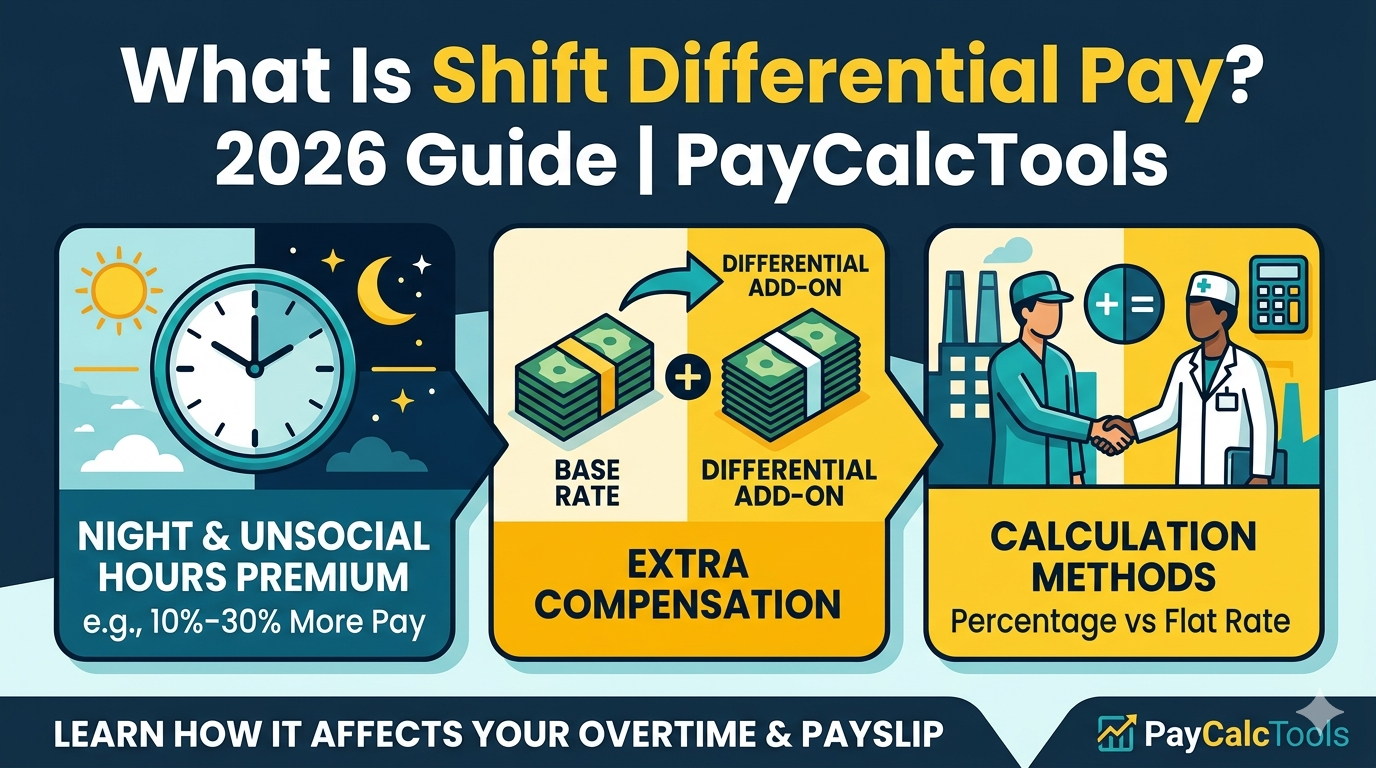
Shift differential pay is additional compensation paid to employees who work shifts that are considered less desirable — typically evenings, overnight, weekends, or holidays. It exists because employers need to fill those shifts and workers need an incentive to take them.
A shift differential is most commonly expressed as either a percentage of base pay or a flat dollar amount per hour. For example, a hospital might pay nurses a 15% differential for evening shifts or an extra $3.00 per hour for overnight work.
The practice is widespread in healthcare, manufacturing, transportation, retail, and hospitality — any industry that runs operations around the clock. The Fair Labor Standards Act (FLSA) does not require employers to offer shift differentials, but once an employer establishes a differential policy, it affects how overtime must be calculated (more on that in the legal section below).
In the UK, shift differentials work on the same principle. Employers are not required by the Employment Rights Act 1996 or the Working Time Regulations 1998 to pay a differential, but they must ensure that any additional pay doesn’t cause the effective hourly rate to fall below the National Minimum Wage — currently £12.71 per hour for workers aged 21 and over in 2026.
How Is Shift Differential Pay Calculated?
There are two main methods employers use to calculate a shift differential. Knowing which one your employer uses matters — especially if you work overtime.
Method 1 — Percentage of Base Pay
This is the more common approach. Your employer adds a percentage on top of your regular hourly rate for the hours worked during the differential shift.
Formula: Differential Pay = Base Hourly Rate × Differential Percentage
Example: You earn $20.00 per hour as a base rate. Your employer pays a 15% night shift differential for any hours worked between 11 PM and 7 AM.
- Differential amount: $20.00 × 15% = $3.00 per hour
- Your effective night shift rate: $20.00 + $3.00 = $23.00 per hour
- For an 8-hour overnight shift: 8 × $23.00 = $184.00
Method 2 — Flat Dollar Add-On
Some employers pay a fixed extra amount per hour rather than a percentage.
Formula: Total Pay = (Base Rate + Flat Differential) × Hours Worked
Example: Same $20.00 base rate, but your employer pays a flat $2.50 per hour differential for weekend shifts.
- Weekend rate: $20.00 + $2.50 = $22.50 per hour
- For a 10-hour Saturday shift: 10 × $22.50 = $225.00
The percentage method tends to benefit higher-paid workers more in absolute dollar terms, while the flat-rate method provides equal benefit regardless of base pay. Neither is legally superior — it’s entirely an employer’s discretion which system to use.
What Does US Law Say About Shift Differential Pay?
This is where many workers — and some employers — get it wrong. The Fair Labor Standards Act (FLSA) does not require employers to pay shift differentials at all. There is no federal mandate that night shifts, weekend shifts, or holiday shifts attract higher pay.
However, the FLSA does contain rules about how differentials interact with overtime pay, and that’s where the legal obligations kick in.
Shift Differential and Overtime Under the FLSA
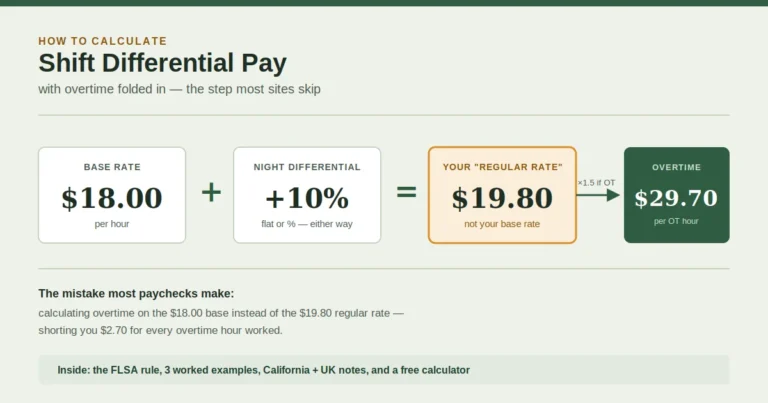
Under FLSA Section 7, non-exempt employees must receive overtime at 1.5 times their “regular rate of pay” for all hours over 40 in a workweek. The key point: shift differentials are generally included when calculating the regular rate of pay.
Example: You work 30 hours at $20.00 (day rate) and 15 hours at $23.00 (night rate with differential) in a single workweek — a total of 45 hours.
- Total weekly earnings: (30 × $20) + (15 × $23) = $600 + $345 = $945
- Regular rate: $945 ÷ 45 hours = $21.00 per hour
- Overtime premium (5 hours over 40): 5 × ($21.00 × 0.5) = $52.50
- Total pay: $945 + $52.50 = $997.50
Using the base rate alone for overtime in this scenario would shortchange the employee. The Department of Labor’s Wage and Hour Division (WHD) enforces these rules and handles complaints if you believe you’ve been underpaid.
UK Legal Position
UK law doesn’t mandate shift differentials either, but employers must respect three key rules. First, the effective hourly rate after accounting for any unpaid breaks must not fall below the National Minimum Wage (National Minimum Wage Act 1998). Second, night workers are subject to the Working Time Regulations 1998, which limit average night work to 8 hours per 24-hour period and entitle night workers to free health assessments. Third, any differential must be applied consistently — paying one group of workers a differential and refusing it to a comparable group doing the same work could create equal pay exposure under the Equality Act 2010.
For free UK workplace advice, contact ACAS on 0300 123 1100.
What Are Typical Shift Differential Rates in 2026?
Shift differential rates vary significantly by industry, role, and employer. The table below shows typical ranges based on 2026 industry data from the US Bureau of Labor Statistics and employer compensation surveys.
| Shift Type | Typical Differential (% of base pay) | Common in |
|---|---|---|
| Evening (3 PM – 11 PM) | 5% – 15% | Healthcare, retail, manufacturing |
| Overnight / Night (11 PM – 7 AM) | 10% – 30% | Healthcare, security, logistics |
| Weekend (Sat / Sun) | 5% – 25% | Hospitality, retail, emergency services |
| Holiday | 25% – 100% (some employers pay double) | Retail, healthcare, transport |
| Rotating shift | 10% – 20% | Manufacturing, energy, utilities |
Healthcare consistently offers the highest differentials — registered nurses working overnight in large hospital systems often see premiums of 20%–30%. Manufacturing and logistics tend to sit at the lower end of the range, typically 5%–15%.
Some employers cap their differential policies by role or pay grade, so a senior engineer and a junior technician working the same overnight shift might receive different percentage premiums. Always check your employment contract or company handbook to confirm your specific entitlement.
H2: Common Mistakes Workers and Employers Make with Shift Differential Pay
Mistake 1 — Not Including the Differential in Overtime Calculations
This is the single most common and costly error employers make. As explained above, the FLSA requires overtime to be based on the blended regular rate of pay, which includes differential earnings. Paying overtime at just the base rate is a wage violation. If you think this has happened to you, you can file a complaint with the DOL Wage and Hour Division.
Mistake 2 — Assuming Shift Differentials Are Legally Required
Workers sometimes believe they’re automatically entitled to extra pay for evenings or weekends. Under US federal law, that’s not the case — a differential only exists if your employer has agreed to pay one in your contract, a collective bargaining agreement, or a published company policy. Check your offer letter and employee handbook.
Mistake 3 — Confusing Shift Differential with Overtime
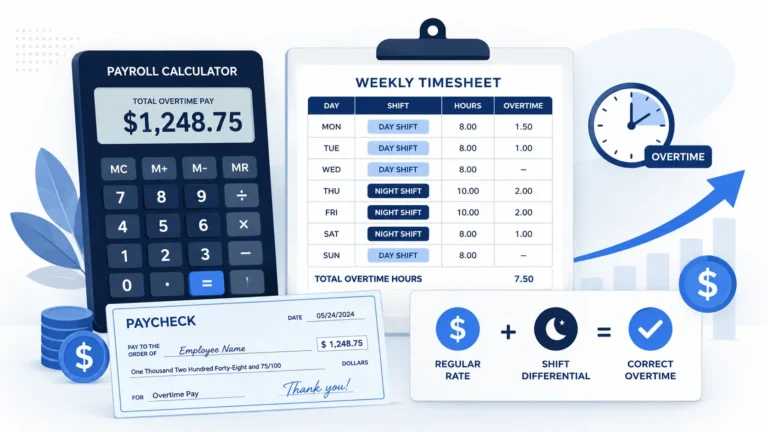
Shift differential vs overtime is a common point of confusion. These are two completely separate things. A shift differential applies because of when you work. Overtime applies because of how many hours you work. You can earn both simultaneously — if you work 45 hours in a week and 10 of those are overnight hours, you may receive a night shift differential on those 10 hours and overtime pay on 5 hours. They don’t cancel each other out.
Mistake 4 — Ignoring Shift Differential in Job Offer Comparisons
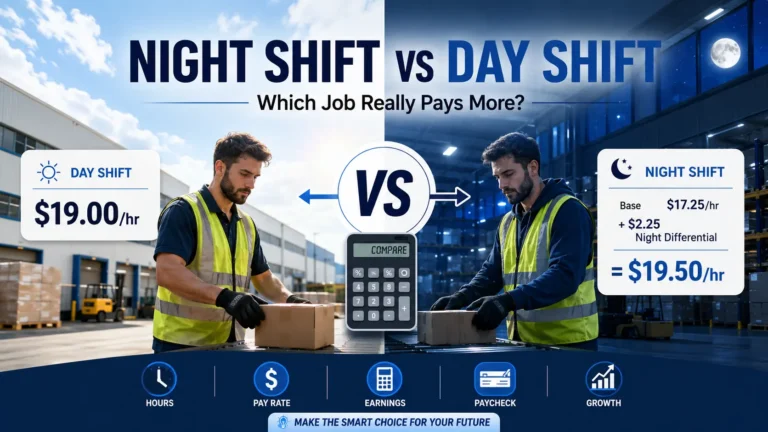
When comparing two job offers, workers often compare base rates without accounting for differentials. A role paying $18.00 base with a 20% overnight differential effectively pays $21.60 for those hours — making it potentially better than a competing offer of $20.00 with no differential, depending on the shift mix.
🔢 Run the Numbers for Your Role
Use our Shift Differential Pay Calculator to see exactly what your take-home looks like across different shift patterns and differential rates. Enter your figures and get results instantly — no account needed. Open Shift Differential Pay Calculator →
Frequently Asked Questions
Q: Is shift differential pay required by law in the US?
No. The Fair Labor Standards Act does not require employers to pay shift differentials. There is no federal law mandating extra pay for nights, weekends, or holidays. The right to a differential comes from your employment contract, company policy, or a collective bargaining agreement — not from statute.
Q: How does shift differential affect overtime pay?
Shift differentials must generally be included when calculating your regular rate of pay under the FLSA. This matters because overtime is paid at 1.5 times that regular rate, not just your base hourly rate. Ignoring differential earnings when calculating overtime is a common wage violation that can result in back-pay liability for employers.
Q: What is a typical night shift differential percentage?
Most night shift differentials in the US range from 10% to 30% of base pay, depending on industry. Healthcare workers tend to receive the highest premiums — often 20% to 30% for overnight shifts — while manufacturing and retail typically offer 10% to 15%. Some employers use flat dollar amounts (e.g., $2–$4 per hour) rather than percentages.
Q: Is shift differential the same as overtime?
No — these are separate forms of compensation. A shift differential is extra pay because of when you work (evenings, nights, weekends). Overtime is extra pay because of how many hours you work (over 40 per week under the FLSA). You can receive both at the same time, and one does not replace the other.
Q: Do salaried employees get shift differential pay?
It depends on your employer’s policy. Salaried workers who are FLSA-exempt are typically not entitled to overtime, but some employers still pay them shift differentials as an incentive. Salaried non-exempt workers can receive both differentials and overtime. Your employment contract or company pay policy will specify whether a differential applies to your role.
You Might Also Find These Useful
If you’re digging into shift pay, these tools can help you work out the full picture:
Overtime Pay Calculator — Once you understand your shift differential rate, use this to calculate how overtime interacts with your blended regular rate across a full workweek.
Freelance Day Rate Calculator — If you’re considering contract work instead of shift-based employment, this tool helps you set a day rate that accounts for the unsocial hours premium you might be leaving behind.
Notice Period Calculator — Changing jobs to get a better shift differential? This tool helps you work out your notice obligations so you can plan your start date without a contractual misstep.
PAGE DISCLAIMER: Results from PayCalcTools tools are for guidance purposes only and do not constitute legal, financial, or professional advice. US content references the Fair Labor Standards Act as enforced at federal level — state laws may provide additional protections. UK employment law as of April 2026. Last reviewed: Sep 2026.