How to Calculate Overtime Pay in California (2026 Rules)
Introduction
California has some of the strongest overtime pay protections in the country — and understanding them could mean real money in your pocket. Whether you work an eight-hour shift or a ten-hour day, overtime pay California law applies differently than federal rules, and getting it wrong costs workers thousands of dollars each year. This guide breaks down exactly how California overtime works in 2026, who qualifies, how to calculate what you’re owed, and the most common mistakes to avoid. By the end, you’ll know your rights and be able to check your own paycheck with confidence.
🔢 Use Our Free Calculator
Calculate your California overtime pay instantly with our free tool. No sign-up. Results in seconds.
What Is Overtime Pay in California?
Overtime pay is additional compensation — at least 1.5 times your regular rate of pay — that employers must pay when you work beyond a set threshold of hours. Under the Fair Labor Standards Act (FLSA), 29 U.S.C. § 207, federal law requires overtime after 40 hours per week. California goes further.
Under California Labor Code § 510, you earn overtime after just eight hours in a single workday — not only after 40 hours in a week. California is one of the only states in the US with this daily overtime rule, which is a major difference from what workers in most other states experience.
Here’s a real-world example: Suppose you work 10 hours on Monday. Under federal law, no overtime applies yet. Under California law, the two extra hours past 8 are overtime hours and must be paid at 1.5× your regular hourly rate. If you earn $20/hour, those two hours pay $30 each — that’s $60 in overtime on a single day.
California overtime law applies to most non-exempt hourly and salaried workers in the state. Exemptions exist for specific roles, including certain managers, professionals, and computer software employees — more on those below.
How Does California Overtime Pay Work? (The Formula)
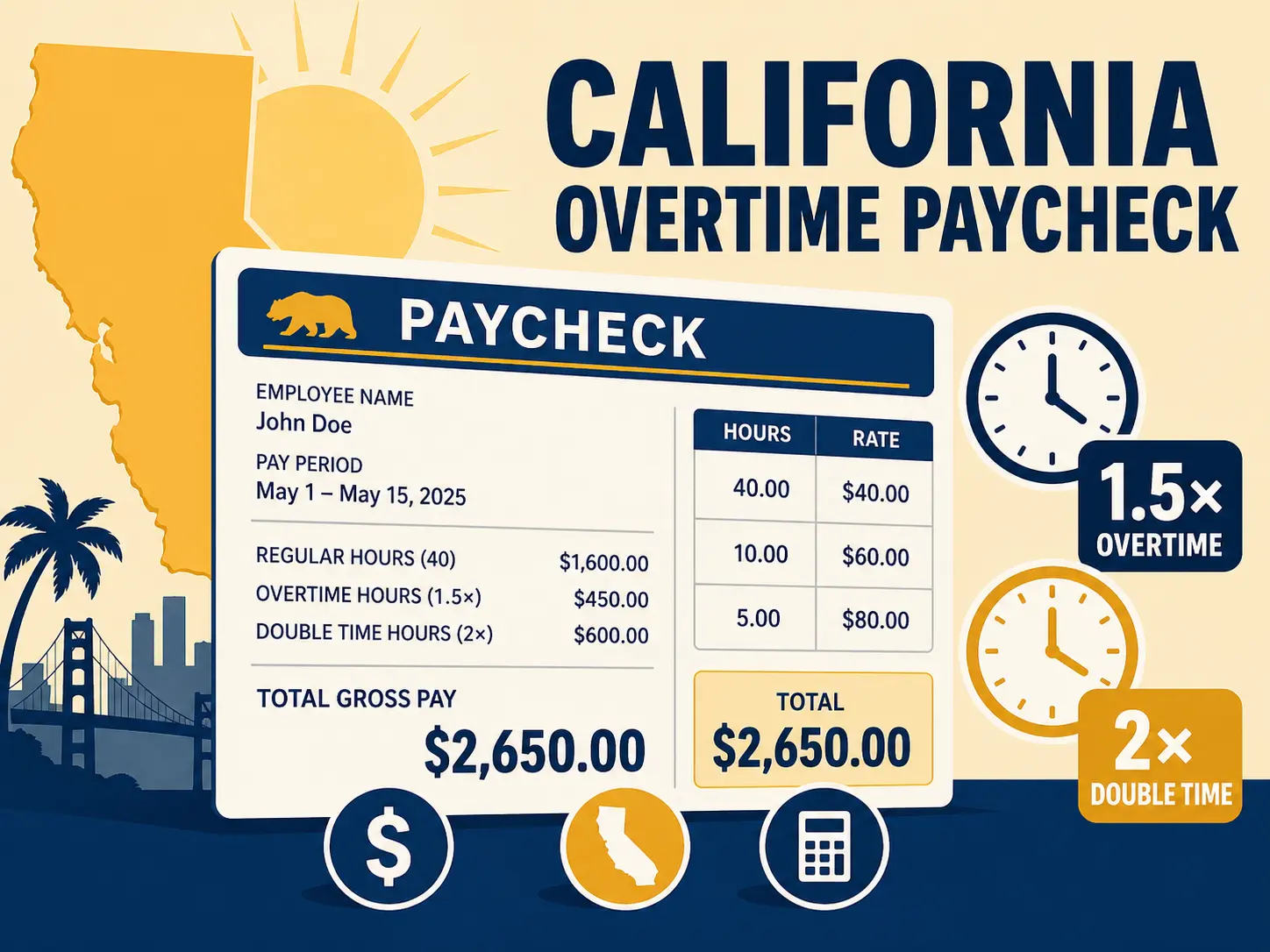
California has a three-tier overtime structure under California Labor Code § 510:
- 1.5× your regular rate for hours over 8 up to 12 in a workday
- 2× your regular rate (double time) for hours over 12 in a workday
- 1.5× your regular rate for hours over 40 in a workweek
- 2× your regular rate for all hours on the seventh consecutive day of a workweek after 8 hours; 1.5× applies for the first 8 hours on that seventh day
The core formula:
Overtime Pay = Hours at Overtime Threshold × (Regular Rate × Overtime Multiplier)
Worked Example — Single Workday:
Maria earns $22.00/hour and works 13 hours on Tuesday.
- Hours 1–8: Regular pay = 8 × $22.00 = $176.00
- Hours 9–12: Overtime at 1.5× = 4 × $33.00 = $132.00
- Hour 13: Double time at 2× = 1 × $44.00 = $44.00
- Total for the day: $352.00
Without California’s daily overtime rule, Maria would only earn $286.00 for the day (13 × $22.00). That’s a $66 difference on a single shift.
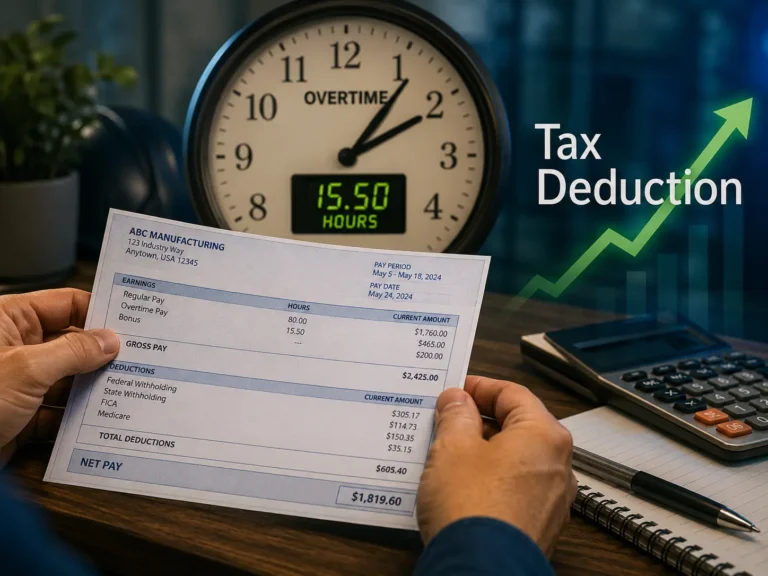
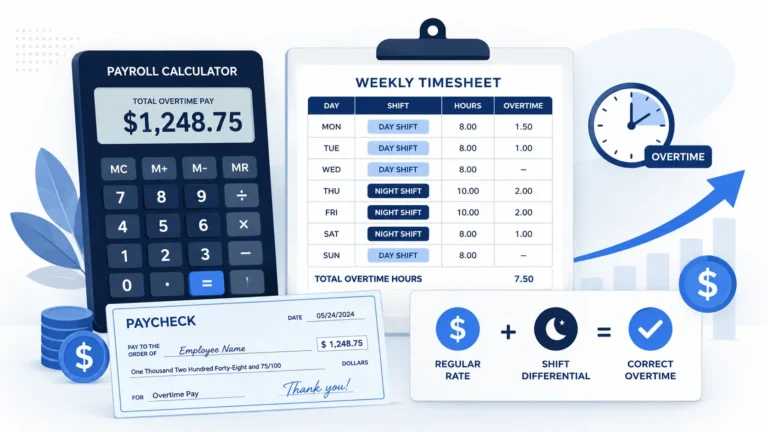
Your regular rate of pay is not simply your hourly wage. Under California law, it includes non-discretionary bonuses, commissions, and shift differentials divided across your total hours worked that week. Use our Shift Differential Pay Calculator to factor in any shift premiums before calculating overtime.
What Are the California Overtime Rules for 2026?
California overtime rules in 2026 are governed by California Labor Code § 510 and enforced by the California Labor Commissioner’s Office. Here are the key rules every worker should know.
Daily vs. Weekly Overtime
Most states only use the federal weekly overtime threshold of 40 hours (FLSA § 207). California adds a daily threshold of 8 hours, meaning you can hit overtime on a single long shift even if your total weekly hours stay under 40.
Double Time Rules
California is one of the few states requiring double-time pay (2×). It applies in two scenarios:
- Any hours beyond 12 in a single workday
- All hours worked on the seventh consecutive day of a workweek (after the first 8 hours; 1.5× applies for hours 1–8 on day seven)
Who Is Exempt?
Not all employees qualify for overtime under California law. Exemptions under California Labor Code § 515 include:
- Executive, administrative, and professional employees earning more than twice the state minimum wage for full-time work (≥$70,720/year in 2026 based on a $34.00/hour minimum wage equivalent)
- Licensed physicians and surgeons earning above a set hourly threshold
- Outside sales employees
- Computer software employees earning at least $55.58/hour (2026 rate — indexed annually)
If you’re unsure about your exempt status, the California Department of Industrial Relations has guidance for workers and employers.
Alternative Workweek Schedules
Some California employers use Alternative Workweek Schedules (AWS), which allow shifts up to 10 hours without daily overtime — but only if the schedule is voted in by two-thirds of affected employees. If your employer claims an AWS but never held a vote, your overtime rights may have been violated.
California Overtime Rates and Thresholds in 2026
California’s state minimum wage is $16.50/hour as of January 1, 2026 (general rate). Some industries have higher minimums — the fast food sector minimum stands at $20.00/hour following AB 1228. These base rates directly affect overtime calculations.
| Overtime Type | Threshold | Multiplier | Example ($20/hr base) |
|---|---|---|---|
| Daily overtime | Over 8 hrs/day | 1.5× | $30.00/hr |
| Daily double time | Over 12 hrs/day | 2× | $40.00/hr |
| Weekly overtime | Over 40 hrs/week | 1.5× | $30.00/hr |
| 7th consecutive day (first 8 hrs) | All hours | 1.5× | $30.00/hr |
| 7th consecutive day (over 8 hrs) | Over 8 hrs | 2× | $40.00/hr |
Source: California Labor Code § 510; California DIR minimum wage schedule 2026.
Note that the weekly 40-hour threshold and daily 8-hour threshold do not stack to create a higher multiplier — you receive whichever overtime applies first, and the higher multiplier (double time) only triggers at 12+ hours in a day or 8+ hours on a seventh consecutive day.
You can verify current rates at dol.gov/agencies/whd for federal comparisons, or the California DIR wage orders for state-specific rules.
Common Mistakes Workers and Employers Make with California Overtime
Mistake 1: Assuming Only Weekly Hours Trigger Overtime
This is the single most common error, and it happens because most people are familiar with the federal rule. California’s daily overtime threshold is 8 hours, so even a single long day can generate overtime owed — regardless of how many total hours you’ve worked that week.
If you work 10 hours on Monday and take the rest of the week off, you are still owed 2 hours of overtime pay. Your employer cannot offset those overtime hours by giving you a shorter day later in the week, unless a valid Alternative Workweek Schedule is in place.
Mistake 2: Forgetting Bonuses and Commissions in the Regular Rate
Many workers (and some employers) calculate overtime solely on the hourly wage. But under California Labor Code § 510 and FLSA § 207(e), non-discretionary bonuses, piece-rate earnings, and shift premiums must be factored into the regular rate of pay before applying the overtime multiplier.
For example, if you earned a $200 production bonus in a 40-hour week at $18/hour, your regular rate is not $18 — it’s ($18 × 40 + $200) ÷ 40 = $23.00/hour. Any overtime in that week must be calculated at $34.50/hour (1.5× $23.00), not $27.00.
Mistake 3: Misclassifying Employees as Exempt
Some employers classify workers as “managers” or “salaried” to avoid paying overtime. In California, a job title alone does not determine exempt status. The duties test under California Labor Code § 515 requires that the employee actually spends more than 50% of their time performing exempt duties. Many “assistant managers” at retail and food service companies fail this test and are entitled to overtime.
🔢 Run the Numbers for Your Situation
Our free overtime calculator handles California’s daily and weekly rules automatically. Enter your hours and rate — your result appears instantly.
Frequently Asked Questions
Does California overtime apply after 8 hours a day or 40 hours a week?
Both. California Labor Code § 510 triggers overtime after 8 hours in a single workday at 1.5×, and again for any hours beyond 40 in a workweek at 1.5×. Double time kicks in after 12 hours in a day. You receive overtime from whichever rule applies first — they don’t combine to create a higher rate.
Can my employer make me take time off instead of paying overtime?
No. Private-sector employers in California cannot substitute “comp time” for overtime pay. Under California law, overtime must be paid as cash wages in the same pay period it was earned. Government employees may have different rules under their collective bargaining agreements.
What if I’m paid a salary — do I still get overtime in California?
It depends on your duties and salary level, not your pay structure alone. Salaried workers who earn less than twice the state minimum wage for full-time work (approximately $70,720/year in 2026), or who do not meet the California duties test under Labor Code § 515, are still entitled to overtime. A salary label does not remove your overtime rights.
How far back can I claim unpaid overtime in California?
California’s statute of limitations for unpaid overtime claims is three years under the California Code of Civil Procedure § 338(a) — or four years if you file a claim under California’s Unfair Competition Law (Business & Professions Code § 17200). This is longer than the federal FLSA limit of two or three years.
Does California overtime apply to independent contractors?
No — California overtime law applies to employees, not independent contractors. However, many workers misclassified as contractors are legally employees under the ABC test established by California’s AB 5 (2019). If you believe you have been misclassified, the California Labor Commissioner’s Office can investigate your situation.
You Might Also Find These Useful
Now that you understand how California overtime works, these tools can help you get a complete picture of your pay:
- Overtime Pay Calculator — Plug in your hourly rate and hours to instantly calculate daily and weekly overtime under California rules.
- Shift Differential Pay Calculator — If you work evenings, nights, or weekends, your shift premium affects your regular rate and therefore your overtime — this tool handles the math.
- Freelance Day Rate Calculator — Freelancers and independent contractors aren’t covered by overtime law, but this calculator helps you set a day rate that reflects the long hours you actually work.
PAGE DISCLAIMER: Results from PayCalcTools tools are for guidance purposes only and do not constitute legal, financial, or professional advice. California employment law cited in this post reflects rules in effect as of January 2026. Laws and minimum wage rates are subject to change. Always consult a licensed employment attorney or the California Labor Commissioner’s Office for advice on your specific situation. Last reviewed: April 2026.