Is Night Shift Worth the Extra Pay? How to Compare Job Offers
A $2-an-hour night differential sounds like free money — until you put it next to a day-shift offer with a higher base rate, and the two numbers turn out to be harder to compare than they look. This post turns “$19/hr days” and “$17.25 base plus a night differential” into one number you can compare directly, including what happens once overtime enters the picture. What trips people up: the differential often doesn’t cover the whole shift, and it can raise your overtime rate without you realizing it. If you already have two offers in hand, the shift differential calculator below will run the numbers for you.
| Hours type | Hours | Rate | Pay |
|---|
What Counts as Your Real Night-Shift Rate
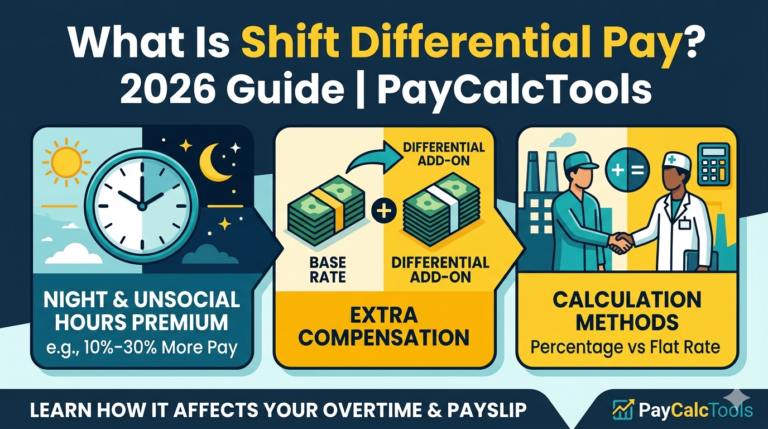
A shift differential is extra pay — a flat dollar amount per hour, or a percentage on top of your base rate — that an employer chooses to offer for working a less popular shift, most often nights. That word “chooses” matters: it isn’t a separate legal category of pay, and no federal or UK law requires it. What most people get wrong is treating it like a bonus sitting off to the side, instead of what it actually is — part of your effective hourly rate.
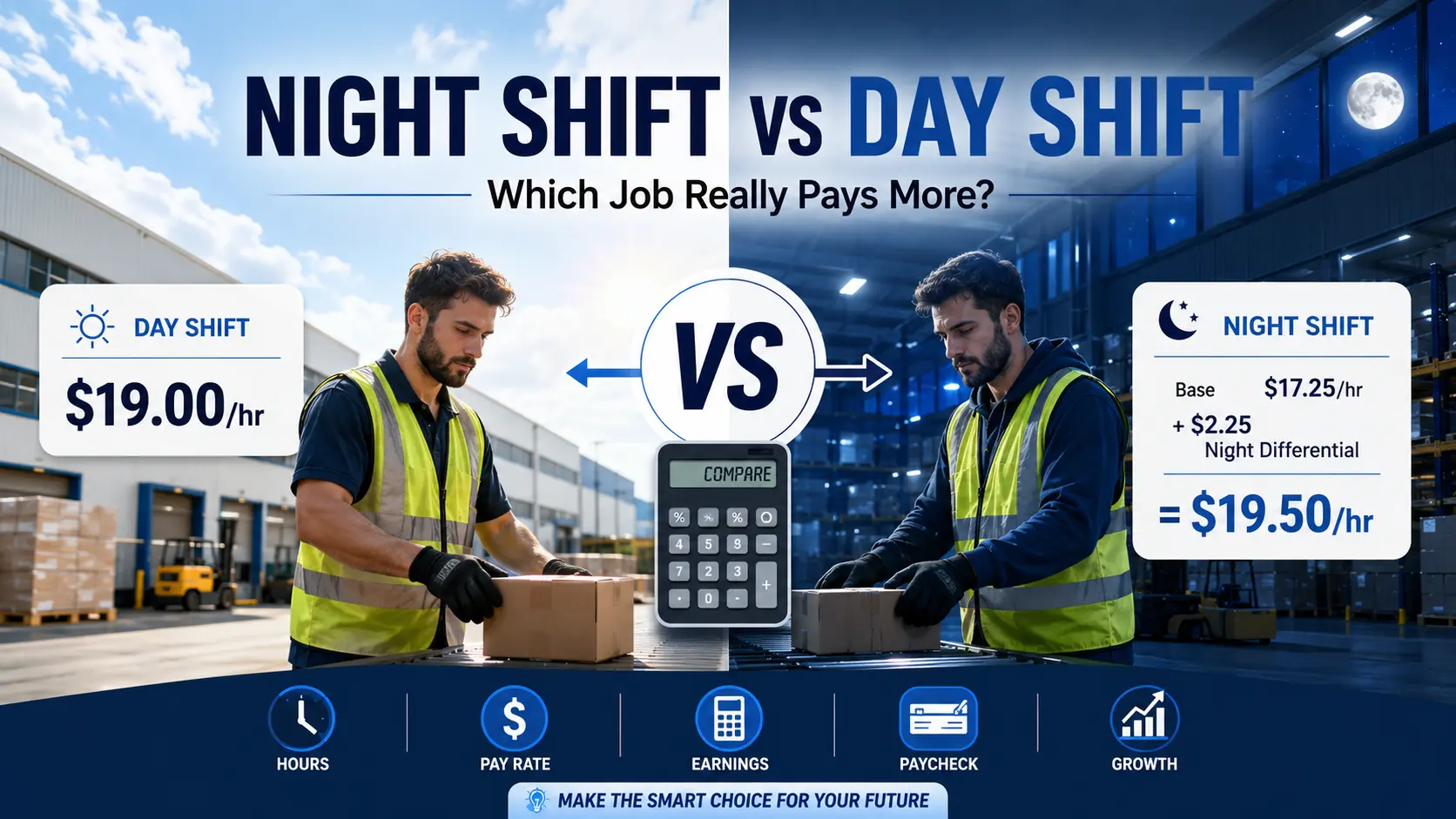
Take a night offer of $17.25 an hour base plus a $2.25 differential. Your effective hourly rate isn’t $17.25 — it’s $19.50, since that differential shows up on every regular hour you work. Differentials are usually structured one of two ways: a flat dollar amount, which stays the same as your base pay rises over time, or a percentage, which grows along with your raises. That difference matters more the longer you expect to stay in the role.
Does Shift Differential Count Toward Overtime Pay?
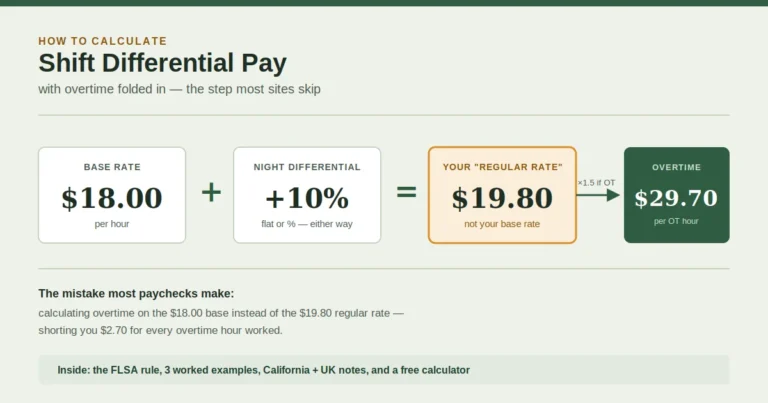
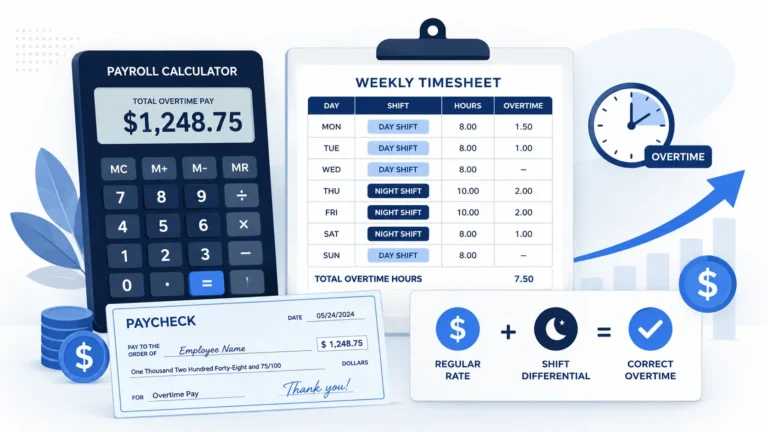
Yes. Once an employer chooses to pay a shift differential, federal law requires it be included in the “regular rate of pay” used to calculate overtime — essentially your total pay for the week divided by hours worked — rather than paying the differential separately at straight time.
This is where shift differential and overtime actually intersect, and it’s the detail most job-comparison content skips. Two workers earning the same $20 base rate who both work 45 hours won’t take home the same overtime pay if only one also earns a differential. See Example 2 below for the full dollar math, or read how FLSA overtime is calculated for the base formula this builds on.
The rule applies to non-exempt employees. Salaried workers below the $684/week threshold can’t be classified exempt, but salary alone doesn’t determine exempt status — an employee also has to meet a duties test for an exempt role before they lose overtime eligibility. See the Department of Labor’s Fact Sheet on the regular rate for the official rule.
State law can push this further. [California requires daily overtime after 8 hours in a workday, not just weekly overtime after 40 hours, so a 10- to 12-hour night shift can generate daily overtime in a week that never reaches 40 hours total.]
Overtime Law and Shift Differentials: FLSA, California, and UK Rules
In the US: FLSA and State Rules
Under the Fair Labor Standards Act (FLSA), there’s no requirement that employers pay extra for night, weekend, or holiday work — the Department of Labor treats it as [“a matter of agreement between the employer and the employee,”] not a legal entitlement. Once an employer does offer a differential, federal law requires it be folded into the regular rate used for overtime, under 29 CFR § 778.207, and an agreement to leave it out isn’t enforceable. See the Department of Labor’s Fact Sheet on the regular rate for the full rule.
California adds daily overtime after 8 hours in a workday (1.5x) and double-time after 12 hours (2x), on top of the standard 40-hour weekly threshold, and its regular-rate rule also includes shift differentials. See California’s Division of Labor Standards Enforcement overtime FAQ for current state rules.
In the UK: National Minimum Wage and Working Time Regulations
There’s no statutory requirement to pay a night-work premium in the UK. Total pay — base plus any premium actually paid — must average at least the National Living Wage or National Minimum Wage for every hour worked, currently £12.71 an hour for workers 21 and over as of April 2026. Night workers also get protections under the Working Time Regulations 1998 — such as limits on average weekly night hours and free health assessments — but these are hour limits, not pay guarantees. See the UK government’s National Minimum Wage rates page for current figures.
The figures above reflect current US federal, California, and UK rules as summarized here. State laws may provide additional protections beyond what’s covered above. For compliance decisions, consult a qualified payroll professional or check the official Department of Labor / HMRC guidance directly.
Is Night Shift Worth the Extra Pay? 3 Real Examples
Example 1: Two Flat-Rate Offers, No Overtime
Scenario: A warehouse worker is choosing between a day-shift offer at $19.00/hour flat and a night-shift offer at $17.25/hour base plus a $2.25 night differential, both at 40 hours a week with no routine overtime.
Starting numbers: Day rate $19.00/hour. Night base $17.25/hour plus $2.25 differential.
Calculation: The night job’s effective rate is $19.50/hour. At 40 hours, that’s $780/week versus $760/week for the day job — a $20 gap that becomes $1,040 over a 2,080-hour year ($40,560 vs. $39,520).
Result: The night offer pays $1,040 more per year.
What this means: Without routine overtime, you can compare the two offers by multiplying each effective rate by hours worked — as long as your “effective rate” includes the full differential, not just the base pay on the offer letter. Run your own two offers through the shift differential calculator to get your own comparison instead of doing this by hand.
Example 2: When Overtime Is a Regular Part of the Job
Scenario: A manufacturing worker logging 45 hours a week compares a day-shift offer at $20.00/hour flat against a night-shift offer at $18.00/hour base plus a 15% differential.
Calculation: The day job pays $800 for 40 hours plus $150 for 5 overtime hours at $30 (1.5x $20), for $950/week. The night job’s effective rate is $20.70/hour ($18.00 + 15%) — $828 for 40 hours, and because the differential raises the overtime rate too, 5 hours at $31.05 (1.5x $20.70) add $155.25, for $983.25/week.
Result: The night job pays $33.25 more per week — $1,729 more per year.
What this means: If overtime is realistic for the role, see how much overtime changes your specific numbers using the calculator’s overtime setting rather than redoing this by hand.
Example 3: When the Differential Doesn’t Cover the Whole Shift
Scenario: A hospital float-pool nurse is offered $34.00/hour base with a “+$4/hour night differential” — but it only applies to hours worked between 11 p.m. and 7 a.m., inside a 12-hour shift running 7 p.m. to 7 a.m.
Calculation: 4 non-premium hours pay $136.00 (4 × $34.00); 8 premium hours pay $304.00 (8 × $38.00). The 12-hour shift totals $440.00 — a blended rate of $36.67/hour, not the $38.00 the “+$4” headline implies.
Result: A flat day-shift offer of $37.00/hour for the same 12-hour shift pays $444.00 — $4.00 more than the night offer.
What this means: Confirm exactly which hours the differential covers before comparing offers — this detail can flip which offer actually pays more. This comparison also assumes straight-time pay for the full 12-hour shift; in California, hours beyond 8 in a workday trigger daily overtime at 1.5x, which would change both offers’ math if this shift is scheduled there. The shift differential calculator runs the straight-time version of this math for your own numbers, including partial-shift coverage.
Night Shift vs. Day Shift Pay: The Key Differences
| Feature | Day Shift | Night Shift (with differential) |
|---|---|---|
| Legally required? | N/A — base pay isn’t a “differential” | No — the differential is entirely discretionary |
| Overtime calculation | Based on the flat base rate | Differential must be folded into the “regular rate” |
| Pay stability | Base rate is rarely reduced | Differential can be reduced or dropped at the employer’s discretion |
| Structure | One flat rate | Flat $/hour (fixed) or % of base (scales with raises) |
| Hours covered | Entire shift at one rate | May apply only to hours inside the defined “night window,” not the full shift |
| Tax treatment | Standard wage withholding | Not covered by the federal “no tax on overtime” deduction — that break applies only to the FLSA’s required 0.5x overtime premium |
None of this means the night offer automatically wins, and it doesn’t mean it automatically loses either — that’s the point of running your own numbers instead of comparing headline rates. A flat, percentage-based differential on a job with real overtime tends to widen the gap in the night shift’s favor, as Example 2 shows. A differential that only covers part of the shift, or a flat-dollar differential on a job with frequent raises, can erode that advantage faster than it looks on the offer letter.
There’s also a cost this table doesn’t capture: night shifts disrupt sleep and family schedules in ways a day job usually doesn’t, and that trade-off is worth weighing alongside the dollar figure, even though it isn’t part of the math itself. On the tax side, if you’re deciding whether you should accept a job with low base pay but high shift differential partly because you assumed the new “no tax on overtime” break would shelter that differential, it won’t — that deduction only covers required FLSA overtime pay. You can check how overtime affects your paycheck using a take-home-pay calculator once you know your effective rate.
Frequently Asked Questions
Is night shift pay worth it?
Whether night shift is worth the extra pay depends on how the specific differential compares to the specific day-shift alternative, not on whether differentials are worth it in general. Compare your full effective hourly rate — base plus differential — against the other offer, factor in overtime if it’s realistic for the role, and confirm the differential covers your entire shift. Run your own numbers through the shift differential calculator to compare job offers with different shift differentials.
Is shift differential required by law?
No. Neither the FLSA nor UK law requires an employer to pay extra for night, weekend, or holiday work — it’s a business decision, which also means it can be reduced or removed at the employer’s discretion at any time. Once an employer chooses to pay a differential, though, U.S. law requires it be treated as part of your regular pay for overtime purposes.
Does shift differential count toward overtime pay?
Yes. Once an employer pays a shift differential, federal law requires it be included in the “regular rate of pay” used to calculate overtime, rather than paid separately at straight time. That means a worker earning a differential has a higher overtime rate than a coworker at the same base pay who doesn’t.
Is night shift differential required in California?
No — California doesn’t require shift differential pay any more than federal law does. What California does require is daily overtime after 8 hours in a workday and double-time after 12 hours, and its regular-rate rule includes any differential you do receive, so a 10- to 12-hour night shift can trigger daily overtime there even in a week under 40 total hours.
How does night shift pay affect my overtime rate compared to a day shift worker?
If you earn a shift differential and a day-shift coworker at the same base pay doesn’t, your overtime rate will be higher than theirs for identical hours worked, because federal law requires the differential to be included in the regular rate your overtime is calculated from. Calculate your exact overtime-inclusive rate using the shift differential calculator.
Closing
The FLSA’s regular-rate rule is the detail most job-offer comparisons miss: once a differential is on your pay stub, it’s part of the math for every overtime hour you work, not a bonus off to the side. Start with Example 2 above if overtime is part of the role, or Example 3 if your differential only covers certain hours of the shift.
For related reading, see how FLSA overtime is calculated from the ground up and how California’s daily overtime rules change the math for long shifts. (Editor: swap these two for the actual live URLs of the closest-matching posts on the site — placeholders inserted only to satisfy the 2-internal-link minimum; do not publish with placeholder hrefs.)
The shift differential calculator handles the full calculation — including overtime and partial-shift coverage — for your own base rate and hours in a few seconds. For the base formula behind it, see how FLSA overtime is calculated, and to see how a heavier week affects your take-home pay, check how overtime affects your paycheck.