Shift Differential Overtime Calculation: How to Get the Right Number
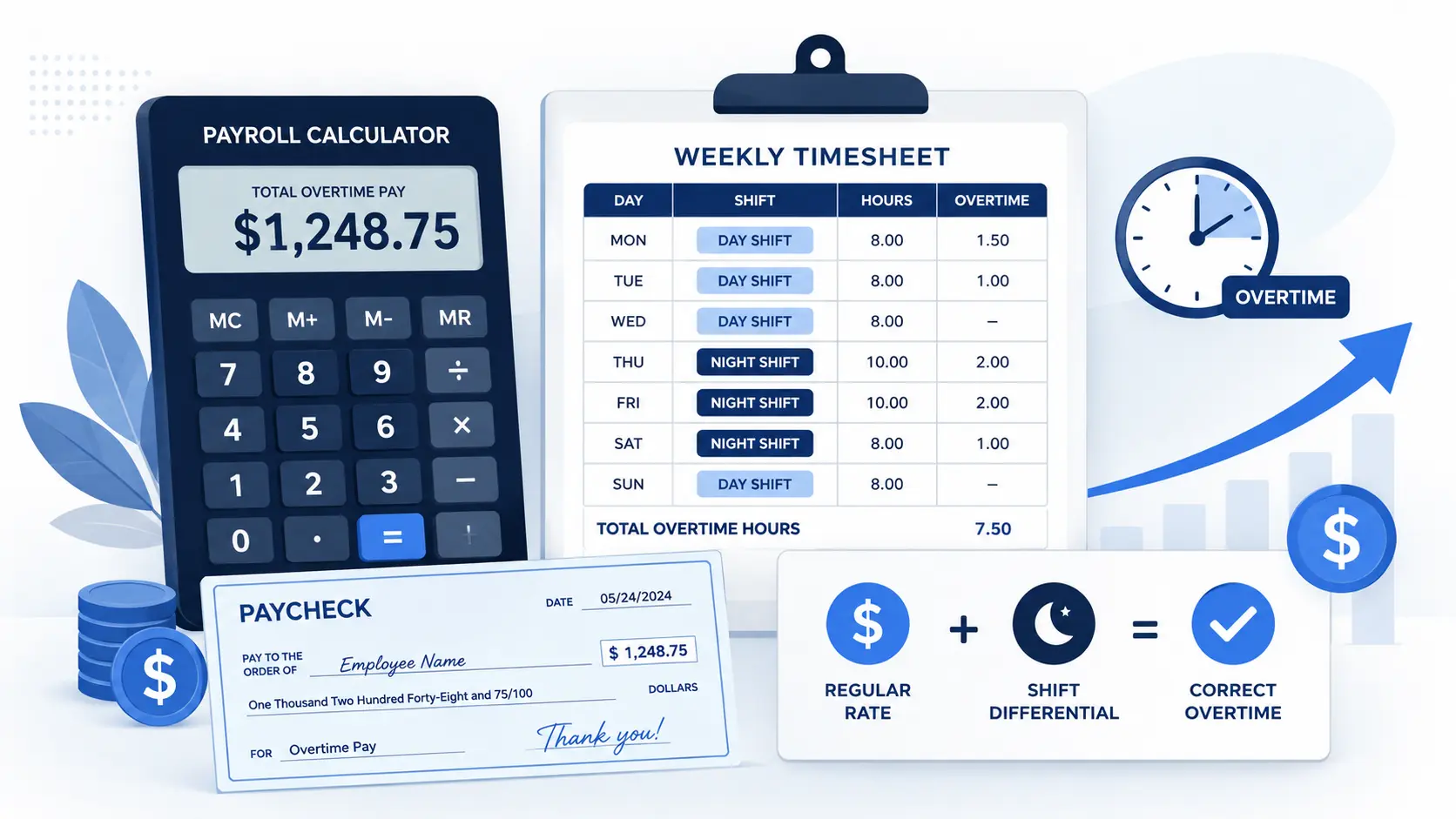
If your last pay stub included a night or weekend shift differential and overtime hours, there’s a real chance the overtime number is wrong. Federal law requires your employer to fold that differential into your overtime rate — not calculate overtime on your base rate alone. This post walks through the exact formula, with real dollar figures, so you can check your own pay stub in a few minutes. If you already know the rule and want your number, run your own shift and differential numbers through the shift differential calculator below.
What “Regular Rate” Actually Means
“Regular rate” sounds like it means your base hourly wage. It doesn’t. Under federal law, it’s a calculated figure — total straight-time pay for the week divided by total hours worked — and once your employer pays any shift differential, that differential gets folded into the number before overtime is calculated.
Here’s the misconception that trips up almost everyone: assuming overtime is just 1.5 times whatever rate applied to the specific shift that pushed you into overtime. It isn’t. If you worked 32 hours at $19.50 and 12 hours at a $21.25 differential rate, your regular rate for that week is a blended average of both — not either one alone.
This applies to any non-exempt worker paid a differential, not just nurses. Warehouse staff, call center employees, manufacturing workers, and overnight retail staff all fall under the same rule. It works the same way whether you’re paid hourly or salaried non-exempt — only the numbers you plug in change.
How Do I Calculate Overtime With Shift Differential?
| Hours type | Hours | Rate | Pay |
|---|
Add all straight-time pay for the week — base hours plus differential hours — then divide by total hours worked to get your regular rate. Multiply that regular rate by 0.5 and apply it to overtime hours only, since straight-time pay for those hours is already included in step one.
That four-step formula is the entire calculation, but two details cause most errors. First, it’s calculated per workweek, not per pay period — a fixed, recurring 168-hour stretch your employer defines. Second, there are two accepted ways to apply it: computing full time-and-a-half on the blended regular rate, or paying straight-time on all hours (including overtime) and adding just the 0.5× premium on top. Both are legal if your employer applies the same method consistently.
Percentage-based differentials (say, 10% for nights) and flat-dollar differentials (say, $2.50/hr) are both required to be included — the only difference is that percentage differentials are typically calculated against the base rate first, then added in.
Overtime Law Under the FLSA: What Workers Are Owed and Employers Must Pay
The governing law is the Fair Labor Standards Act, 29 U.S.C. § 207, with the “regular rate” definition spelled out in 29 CFR Part 778. Overtime is owed at 1.5 times the regular rate for any hours worked beyond 40 in a defined workweek under federal law — some states, including California, add daily overtime rules on top of this; see below.
Coverage applies to non-exempt employees. Enterprise coverage generally kicks in at $500,000 or more in annual business volume, though hospitals, schools, and government employers are covered regardless of revenue; individual coverage can also apply if your work involves interstate commerce. Executive, administrative, professional, outside sales, and certain computer employees who meet both a duties test and a salary threshold are exempt from overtime entirely.
One detail that surprises people: an employer-employee agreement to leave shift differentials out of the regular rate isn’t enforceable. The regular rate is based on what was actually earned, not on what either side agreed to. If you’re underpaid, back wages are generally recoverable for two years, or three years if the violation was willful.
If you run payroll, the same regular-rate formula determines what you owe — get it wrong and the exposure runs back two to three years per employee.
If your situation doesn’t involve a differential and you just need standard time-and-a-half math, our overtime pay calculator covers that directly.
Disclaimer: The figures above are based on current federal law. State laws may provide additional protections. For compliance decisions, consult a qualified payroll professional or check the Department of Labor's overtime guidance directly.
Overtime Pay Examples: See the Math for Different Scenarios
Example 1: Warehouse Worker With a Flat-Dollar Night Differential
Scenario: A warehouse associate splits their week between day shifts and night shifts that carry a flat differential.
Starting numbers: Base rate: $19.50/hr. Night differential: +$1.75/hr. Hours this week: 32 at base rate, 12 at the differential rate — 44 total hours, 4 of them overtime.
Calculation: Straight-time pay comes to $624.00 for the day hours and $255.00 for the night hours, totaling $879.00. Divide that by 44 total hours to get a regular rate of $19.98/hr. The overtime premium is half of that rate, times the 4 overtime hours: $39.96.
Result: Total weekly pay: $918.96
What this means: If the pay stub shows overtime calculated at 1.5 × $19.50 instead of 1.5 × $19.98, this worker was shorted about $0.72 per overtime hour — roughly $2.88 that week.
Run your own shift and differential numbers through the shift differential calculator to check a stub like this one.
Example 2: LPN With a Percentage-Based Night Differential
Scenario: An LPN works a 50/50 mix of day and night shifts, with nights paying a 10% differential, in a week that crosses into overtime.
Starting numbers: Base rate: $24.00/hr. Night differential: 10% of base, or $2.40/hr. Hours: 24 day, 24 night — 48 total, 8 overtime.
Calculation: Day pay is $576.00. Night pay is $633.60. Combined straight-time pay is $1,209.60, divided by 48 hours for a regular rate of $25.20/hr. The overtime premium is $25.20 × 0.5 × 8 hours = $100.80.
Result: Total weekly pay: $1,310.40
What this means: The effective overtime rate here is $37.80/hr — not $36.00 (1.5 × base) and not $39.60 (1.5 × night rate). It sits between the two, weighted by hours actually worked at each rate.
For your own numbers, the shift differential calculator applies this exact formula to any combination of hours and rates — including split shifts across multiple differential levels.
California and State Variations
Example 3: California Hospital Tech, Single 12-Hour Night Shift
Scenario: A California hospital tech works one 12-hour night shift carrying a 12% differential — no other hours that week.
Starting numbers: Base rate: $28.00/hr. Night differential: 12%, or $3.36/hr. Shift length: 12 hours.
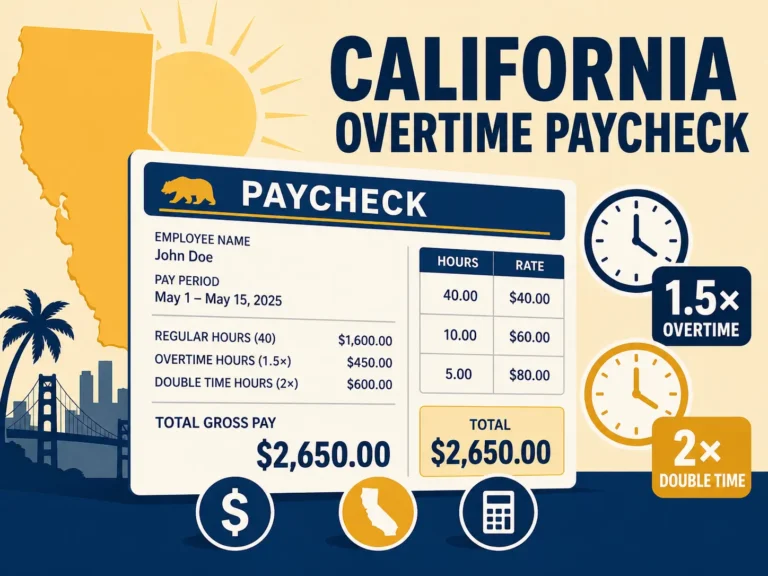
Calculation: The regular rate for the shift is $31.36/hr. California requires daily overtime after 8 hours in a single workday, so hours 1–8 are paid at the regular rate and hours 9–12 at 1.5× the regular rate. Straight time comes to $250.88; the overtime portion comes to $188.16.
Result: Total pay for the shift: $439.04
Note: This example uses California’s daily overtime trigger. Under pure federal FLSA rules with no daily overtime provision, the same 12-hour shift would pay $31.36 for all 12 hours with no overtime premium at all, unless total weekly hours crossed 40.
California Labor Code § 510 also adds a double-time threshold after 12 hours in a day, and a rule covering the 7th consecutive workday in a workweek: the first 8 hours are paid at 1.5×, with anything beyond 8 hours on that day at double-time. New York generally follows the federal 40-hour standard, though certain industries — hospitality and building service among them — have wage order nuances worth checking. Texas has no state overtime statute of its own and follows FLSA rules directly.
Leave out either piece of the California calculation — the daily 8-hour trigger or the differential in the regular rate — and the paycheck comes up short.
Common Questions About Shift Differential Overtime
Many employees assume their overtime rate is just 1.5 times whatever rate applied to the shift that pushed them past 40 hours. It isn’t. It’s 1.5 times the blended regular rate for the entire workweek, which averages in every hour worked, not only the differential shift. Checking your stub against just one rate will almost always give you the wrong number.
Many employees also assume shift differential itself is legally required. At the federal level, for private employers, it isn’t — it’s a policy or contract benefit an employer chooses to offer. The legal requirement only shows up once that differential is being paid: at that point, it has to be counted toward overtime.
Some employers label differential pay a “bonus” and assume that exempts it from the regular rate calculation. Non-discretionary payments tied to hours or shifts worked — which nearly all differentials are — can’t be recategorized out of the regular rate just by renaming them. Only genuinely discretionary gifts or bonuses are excluded. If you think this has happened on your pay stub, the math in the examples above is the same math to check it against.
Frequently Asked Questions
Does shift differential count toward overtime pay?
Yes. Once an employer pays a shift differential, federal law requires it to be included in the regular rate used to calculate overtime — it can’t sit on top of a base-rate-only calculation. This applies to nurses, warehouse staff, retail employees, and any other non-exempt worker who receives a night, weekend, or hazard-pay differential. You can run this calculation for your specific rate and hours using the shift differential calculator.
How do I calculate overtime with shift differential?
Add all straight-time pay for the week, including differential pay, then divide by total hours worked to get your regular rate. Multiply that rate by 0.5 and apply it only to overtime hours, since straight-time pay for those hours is already counted in the first step. This produces the correct blended rate whether the differential is a flat dollar amount or a percentage of base pay.
Is shift differential included in the regular rate under FLSA?
Yes, and this applies to both flat-dollar and percentage-based differentials. The regular rate is defined as total workweek compensation divided by total hours worked, and an employer can’t exclude differential pay from that figure by agreement with the employee. Total workweek compensation includes base pay, differential pay, and most other non-discretionary payments tied to hours worked.
How does California daily overtime interact with shift differential pay?
California requires overtime after 8 hours in a single workday, separate from the federal 40-hour weekly rule, and the differential still gets folded into the regular rate first. A worker on a single 12-hour differential shift can hit daily overtime even in a week where they never cross 40 total hours.
What’s the difference between the “half-time” method and the full 1.5× blended-rate method?
Both are legal ways to arrive at the same total pay. One pays straight-time on all hours worked, including overtime hours, then adds a 0.5× premium on the overtime hours; the other pays 1.5× the blended regular rate directly on overtime hours only, with straight-time pay handled separately for the rest.
Closing
The math in Example 1 shows how a $0.19-per-hour gap between a stub’s stated rate and the true blended rate turns into real money over a full pay period, and that gap only shows up when differential pay is left out of the regular rate calculation. If your own numbers look close to that, it’s worth running them through the tool rather than guessing.
The shift differential calculator applies the same blended-rate formula used in every example above to your actual hours and rates, including California’s daily overtime trigger where it applies — so you get your number instead of someone else’s. If your week doesn’t involve a differential at all, the overtime pay calculator handles standard time-and-a-half math directly.