How to Calculate Shift Differential Pay (Including Overtime Weeks)
Your shift differential adds a premium to your base hourly rate for working nights, weekends, or holidays — but the moment overtime enters the same week, the math changes. This post gives you the exact formula, including the step almost every competitor site skips: folding your differential into your “regular rate” before calculating time-and-a-half. What trips people up is realizing that once an employer offers a differential, it legally has to count toward overtime — it can’t just sit on top as a separate line item.
What is shift differential pay, and is it required?
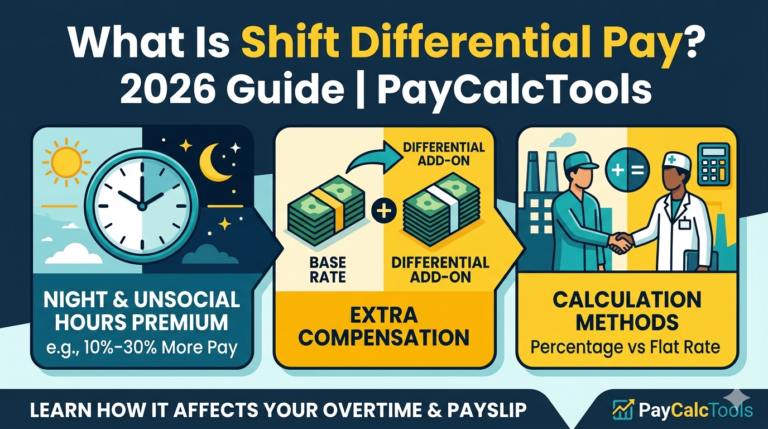
Shift differential is extra pay layered on top of your base hourly rate for working a shift your employer considers less desirable — typically nights, weekends, holidays, or rotating shifts. It shows up two ways: a flat add-on (say, +$2.00/hour) or a percentage bump (say, +10%). Either way, it’s ordinary taxable wages, not a bonus and not a separate pay category.
Here’s what most people get wrong: they assume it’s a legal entitlement, the way overtime is. It isn’t. No federal law requires an employer to pay a shift differential at all — it exists purely because your employer chose to offer it, or because a union contract requires it. This applies to hourly, non-exempt workers (employees legally entitled to overtime pay) across nearly every industry, from warehouse and hospital shifts to retail and manufacturing.
How do you calculate shift differential?
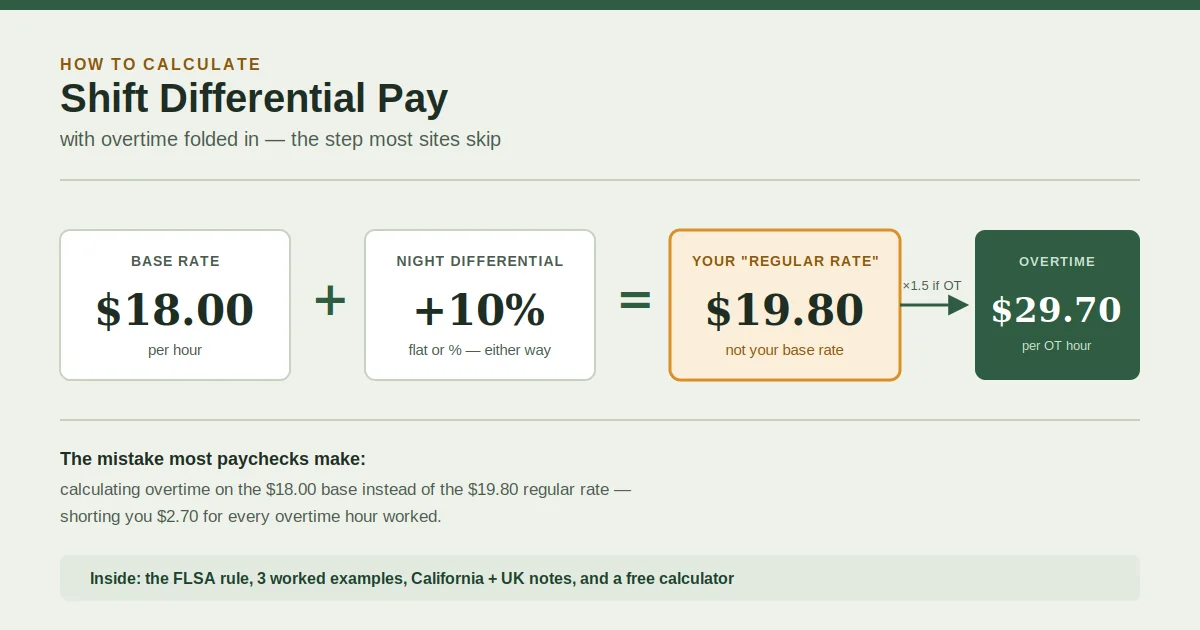
Quick answer: Add the differential to your base rate. Flat-dollar: base rate + differential = effective hourly rate. Percentage: base rate × (1 + differential %) = effective hourly rate. If you work overtime that same week, this effective rate — not your base rate — becomes your “regular rate” for time-and-a-half.
That last sentence is the one paycheck stubs get wrong most often. Under the FLSA’s regular-rate rules, once a shift differential is paid, it must be included when figuring out what 1.5x actually means for that week — you can’t calculate overtime on the base rate alone and treat the differential as untouched.
State rule: California requires daily overtime after 8 hours in a single workday, on top of the weekly 40-hour trigger — which changes when overtime, and therefore this calculation, kicks in.
If you’re checking your own pay, start with the flat or percentage formula above, then ask: did I work more than 40 hours this week? If yes, keep reading — the number you land on next depends on it.
Shift differential and the FLSA: what the law actually requires
Federal rules (U.S.)
The governing law here is the Fair Labor Standards Act, specifically the regular-rate-of-pay provisions at 29 U.S.C. § 207 and 29 CFR § 778. The FLSA doesn’t say anything about shift differentials directly — it doesn’t require employers to pay extra for nights, weekends, or holidays. That’s confirmed by the Department of Labor itself. What the FLSA does require is overtime at 1.5x the “regular rate” for any hours worked over 40 in a week, for employees classified as non-exempt.
Here’s the rule your employer is legally required to follow, even if your pay stub doesn’t reflect it: if a differential is paid, it must be folded into that regular rate before the overtime multiplier is applied — and an employer and employee can’t agree around this. The Department of Labor has been explicit that an agreement to exclude shift differentials from the regular rate is unenforceable, even if both sides sign off on it.
This regular-rate math only applies if you’re non-exempt. If you’re salaried at $684/week or more in an executive, administrative, or professional role, you’re likely exempt — meaning none of this overtime calculation applies to you, even if you get a differential. Your employer is also required to keep records of your hours at each rate for at least two to three years.
State law can extend these protections further. California has no shift-differential mandate itself, but layers on its own rules around daily overtime that change when this calculation gets triggered.
Disclaimer: the figures above are based on current federal law. State laws may provide additional protections. For compliance decisions, consult a qualified payroll professional or check the official Department of Labor / HMRC guidance directly.
Step by step: calculating shift differential pay
These steps use the standard U.S. federal 40-hour/week overtime trigger. In the UK? Skip to the UK section below — the FLSA’s 40-hour rule doesn’t apply there.
- Confirm your base hourly rate. Check your offer letter or most recent pay stub if you’re not sure.
- Confirm the differential amount and type. Flat dollar (+$2.00/hour) or percentage (+10%)? Your handbook or payroll department can confirm this.
- Calculate your effective hourly rate. Flat-dollar: add the differential to your base rate. Percentage: multiply your base rate by (1 + the percentage as a decimal).
- Multiply by hours worked, if there’s no overtime. 40 or under: pay for differential hours is the effective rate × hours worked.
- If you worked overtime, recalculate your “regular rate” first. Your effective hourly rate (base + differential) becomes your regular rate — not your original base rate.
- Apply the overtime multiplier. Multiply the regular rate by 1.5, then multiply by your overtime hours (anything over 40 for the week).
- Mixed base-rate and differential-rate hours in one week? Use the weighted-average method: add total straight-time earnings across all rates, divide by total hours to get your regular rate, then pay an extra half-time premium on overtime hours.
How the calculation works: 3 real examples
Example 1: Full night-shift week, no overtime
Warehouse associate, 40 hours, flat differential.
| Base rate | $19.50 / hour |
| Differential (flat) | +$2.00 / hour |
| Effective rate | $21.50 / hour |
| Hours worked | 40 |
| Total pay | $860.00 |
No overtime complications here — if your own paycheck for a straight differential week doesn’t match, that’s worth flagging with payroll.
Example 2: Evening shift, 45-hour week
Hospital housekeeping employee, overtime triggered, percentage differential.
| Base rate | $18.00 / hour |
| Differential | +10% |
| Regular rate | $19.80 / hour |
| Straight time (40 hrs) | $792.00 |
| Overtime rate (×1.5) | $29.70 / hour |
| Overtime pay (5 hrs) | $148.50 |
| Total pay | $940.50 |
Calculating overtime off the $18.00 base instead would short this employee $2.70 for every overtime hour worked.
Example 3: Blended day and night shifts
Manufacturing employee, 45 hours across two rates, weighted-average method.
| Day shift (35 hrs @ $20.00) | $700.00 |
| Night shift (10 hrs @ $22.00) | $220.00 |
| Regular rate ($920 ÷ 45) | $20.44 / hour |
| Half-time premium (5 OT hrs) | $51.11 |
| Total pay | $971.11 |
This is the exact calculation that trips up manual spreadsheets — and what the shift differential calculator runs automatically.
State-specific notes: California’s split shift premium
Many California workers assume “shift differential” and the “split shift premium” are the same thing. They aren’t. California has no state law requiring a shift differential itself. But it does require something separate: a split shift premium — one extra hour of pay at the applicable minimum wage whenever a workday includes two shifts separated by more than a one-hour unpaid, non-meal break.
- Shift differential depends on WHEN you work — nights, weekends, holidays.
- Split shift premium depends on the SHAPE of your day — a gap in the middle.
A continuous night shift with a differential doesn’t earn a split shift premium just because it’s an unusual hour — and a split daytime shift doesn’t earn a differential just because of the gap.
UK note: shift allowance / unsocial hours pay
There’s no UK statute that directly requires a “shift allowance” for nights, weekends, or unsociable hours — it’s largely down to your employment contract, a collective agreement, or established custom and practice. The only legal floor is that your average hourly pay across the pay period still meets National Minimum Wage requirements, alongside the working-time limits set out under the Working Time Regulations 1998.
Exception: NHS staff covered by the Agenda for Change framework receive nationally negotiated enhancements for nights, Saturdays, Sundays, and bank holidays — percentages are set by pay band and revised each annual pay round, so check the current handbook rather than a fixed figure.
What to do if you think you were underpaid
Start by pulling your pay stubs for the weeks in question, along with your handbook or offer letter showing your base rate and differential terms. Run the numbers using the regular-rate method above — if your overtime pay was calculated off your base rate instead of your base-plus-differential rate, that’s the specific error to point to when you raise it with payroll.
If payroll can’t resolve it, you generally have the right to file a wage claim with the Department of Labor’s Wage and Hour Division, within a statute of limitations that’s typically two years for standard violations and three years for willful ones. This isn’t legal advice for your specific situation — for a real dispute, an employment attorney or your state labor department can tell you exactly where you stand.
Frequently asked questions
How do you calculate shift differential?
Add a flat dollar amount or a percentage to your base hourly rate to get your effective rate. If you also worked overtime that week, that effective rate — not your base rate — becomes your “regular rate” for calculating time-and-a-half pay on hours over 40.
Is shift differential pay required by law?
No. Shift differential pay isn’t required under federal law — the Department of Labor treats it as a matter of agreement between employer and employee, not a legal entitlement like overtime. Some union contracts or state-specific rules may require it in particular workplaces.
Does shift differential count toward overtime?
Yes. Once an employer pays a shift differential, it must be included in the “regular rate” used to calculate overtime — this isn’t optional, and an agreement to exclude it isn’t enforceable. Overtime should be calculated on your base rate plus the differential, not the base rate alone.
What’s the difference between shift differential and split shift pay in California?
They’re legally separate. Shift differential is extra pay for working an undesirable time of day and isn’t required by California law. The split shift premium is one hour of pay at minimum wage, owed when a workday is split by more than an hour of unpaid, non-meal time — it’s about the shape of the schedule, not the hour of day.
How do you calculate shift differential when you work a mix of shifts in one week?
Use the weighted-average method: add total straight-time earnings across all rates, divide by total hours to get your regular rate, then pay an extra half-time premium on overtime hours. This is the calculation most manual payroll systems get wrong.
The bottom line
The math itself isn’t complicated — it’s the regular-rate rule that trips people up, especially in a blended week like the third example above, where a $51.11 overtime premium can easily get missed by a spreadsheet built for flat rates.
If you need to check your own week, the shift differential calculator handles flat and percentage differentials, straight overtime weeks, and blended-rate weeks with the same weighted-average math used above.