
How to Set Your Freelance Day Rate in 2026 (With Calculator)
Most freelancers either underprice themselves out of financial stability or overprice themselves out of the market — and both mistakes trace back to the same root problem: no formula. Knowing how to set your freelance day rate is one of the most important financial decisions you’ll make as an independent worker, yet most guides skip the maths entirely.
This post walks you through the exact method used by experienced contractors in both the US and UK. You’ll get a clear formula, worked examples with real 2026 numbers, legal context on both sides of the Atlantic, and benchmark rates by sector. By the end, you’ll have a number you can confidently quote to any client.
🔢 Use Our Free Calculator
Calculate your freelance day rate instantly with our free tool. Plug in your target income, expenses, and working days — and get your rate in seconds. No sign-up. Results in seconds. Open Freelance Day Rate Calculator →
What Is a Freelance Day Rate?
A freelance day rate (also called a contractor day rate) is the fee you charge a client for a full day’s work — typically eight hours. Unlike a salary, it’s not smoothed across 52 weeks; you only earn it when you work, so it must account for everything a payroll employer normally covers.
Think of it this way: a salaried employee earning $75,000 per year in the US, or £55,000 in the UK, doesn’t personally fund their own pension, employer taxes, equipment, or sick days. A freelancer does — and your day rate is the mechanism for covering all of it.
For US workers, the IRS classifies most freelancers as self-employed, which means you’re responsible for self-employment tax (currently 15.3% on net earnings up to $168,600 for 2026) on top of income tax. In the UK, the equivalent distinction falls under HMRC’s employment status rules, and most contractors operate as either sole traders or through a Personal Service Company (PSC).
The day rate is not the same as your desired take-home pay. It is a gross figure that must work backwards from your financial needs.
How Do You Calculate a Freelance Day Rate?
The formula is three steps. Work through each one and you’ll arrive at a defensible number rather than a guess.
Step 1 — Set your target net annual income. Decide what you want to take home after tax. Be honest: include rent or mortgage, food, savings, and lifestyle costs.
Step 2 — Add your business costs. Annual expenses include software subscriptions, equipment, professional insurance, accountancy fees, training, and — critically — the employer-equivalent taxes you’ll pay. In the US, budget roughly 30–35% of gross for federal and state taxes plus self-employment tax. In the UK, budget for National Insurance contributions (Class 4: 6% on profits between £12,570–£50,270 for 2026/27) and income tax.
Step 3 — Divide by your billable days. Not all 365 days are billable. Subtract weekends, public holidays (around 10 in the US; 8 in England), annual leave (allow at least 20 days), sick days (budget 5–10), and unpaid time spent on admin, pitching, and business development (typically 20–30%).
The formula:
(Target Net Income + Business Costs + Tax Provision) ÷ Billable Days = Minimum Day Rate
Worked example — US freelancer:
- Target net income: $60,000
- Business costs: $8,000
- Tax provision (33%): ~$26,000
- Total gross needed: ~$94,000
- Billable days: 220 days worked minus 40 days non-billable = 180 billable days
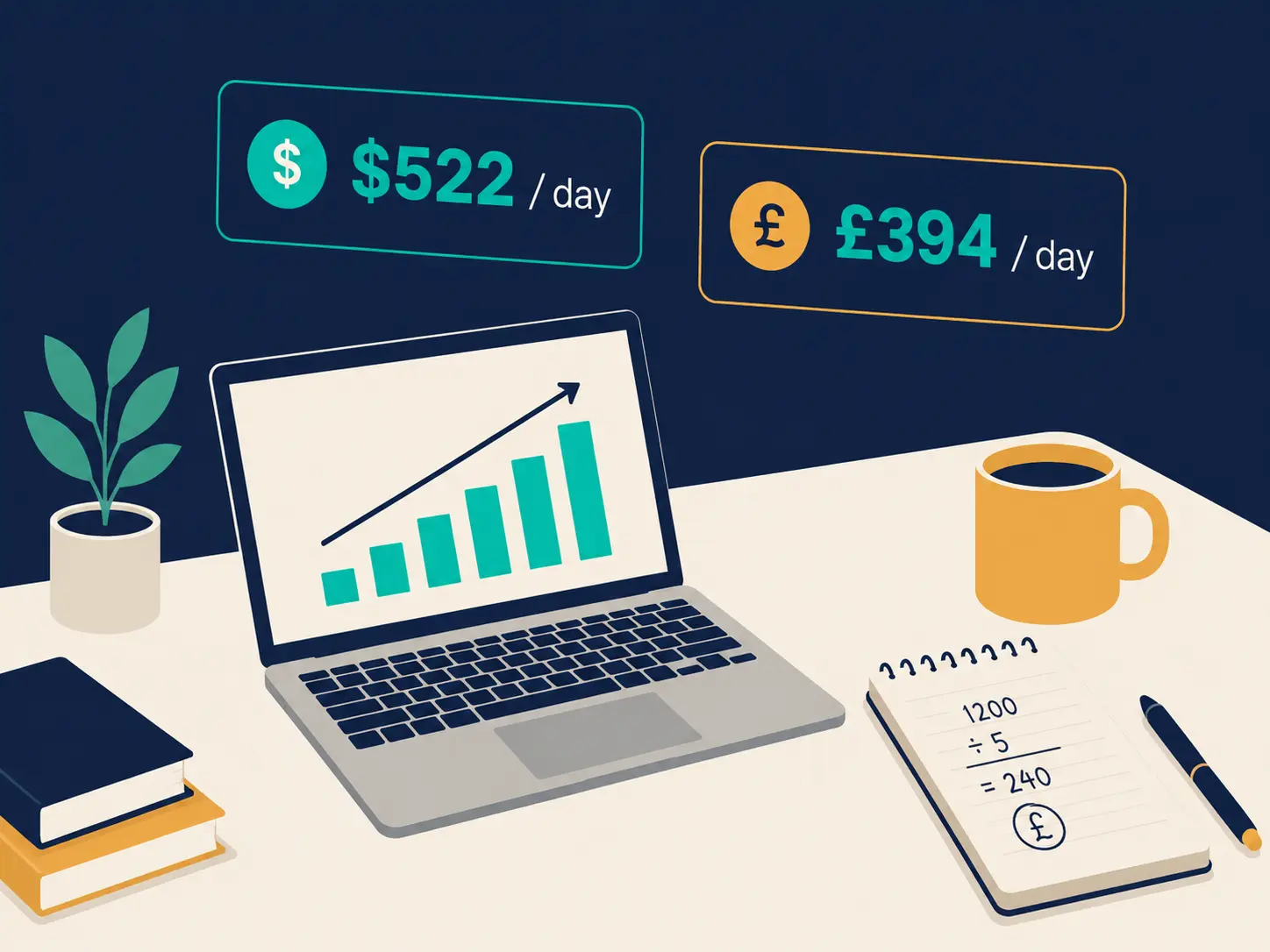
- Minimum day rate: $94,000 ÷ 180 = $522/day
Worked example — UK freelancer:
- Target net income: £45,000
- Business costs: £6,000
- Tax provision (28%): ~£18,000
- Total gross needed: ~£69,000
- Billable days: 175 (220 minus holidays, admin, leave)
- Minimum day rate: £69,000 ÷ 175 = £394/day
This is your floor — the rate below which you lose money. Your actual rate should be higher to reflect market demand and expertise.
What Are the Legal and Tax Rules for Freelancers?
US: Self-Employment Tax and Classification
Under US federal law, freelancers are generally treated as independent contractors. The Fair Labor Standards Act (FLSA), 29 U.S.C. § 203, defines employment but excludes genuinely self-employed individuals from its minimum wage and overtime protections — meaning there is no legal minimum day rate for freelancers.
What you do owe is self-employment tax: the IRS requires you to pay both the employee and employer halves of Social Security and Medicare, totalling 15.3% on the first $168,600 of net self-employment income in 2026, and 2.9% above that. You can deduct half of this as a business expense. Full details are at dol.gov/agencies/whd.
You must also file quarterly estimated taxes (Form 1040-ES) to avoid underpayment penalties. Missing these is one of the most expensive mistakes new US freelancers make.
UK: IR35 and National Insurance
In the UK, your tax position depends heavily on IR35 — the off-payroll working rules introduced under the Income Tax (Earnings and Pensions) Act 2003. If HMRC determines you are operating as a “disguised employee” rather than a genuine business, your income may be taxed at employment rates, eliminating most contractor tax advantages.
If you’re working inside IR35, your take-home rate needs to be significantly higher to reach the same net income, because you lose access to dividend-salary splitting through a PSC. Use HMRC’s Check Employment Status for Tax (CEST) tool to assess your contracts before quoting.
From April 2026, the Class 4 National Insurance rate is 6% on profits between £12,570 and £50,270. Factor this into your gross-up calculation.
What Are Typical Freelance Day Rates in 2026?
Day rates vary enormously by discipline, experience, and location. The table below shows indicative mid-market rates for experienced freelancers (3–7 years’ experience) in 2026.
| Discipline | US Day Rate (USD) | UK Day Rate (GBP) |
|---|---|---|
| Software Developer (mid-level) | $600 – $900 | £400 – £650 |
| UX/Product Designer | $500 – $750 | £350 – £550 |
| Digital Marketing Consultant | $400 – $650 | £280 – £450 |
| Financial Consultant | $700 – $1,100 | £500 – £750 |
| Copywriter / Content Strategist | $350 – $600 | £250 – £400 |
| Project Manager | $550 – $800 | £380 – £580 |
| Data Analyst | $600 – $950 | £420 – £650 |
Sources: 2026 survey data from Toptal, Freelancer.com, and HMRC employment income statistics. Figures represent median market rates and should be treated as benchmarks, not guarantees.
Location significantly affects rates. A US developer based in San Francisco commands roughly 30–40% more than the same skill set in a mid-tier city. In the UK, London day rates typically run 20–35% above regional equivalents.
Senior freelancers or specialists with niche skills regularly exceed the top of these ranges. If you are working in AI, cybersecurity, or regulated industries (finance, healthcare), add a complexity premium of 15–25% to your base calculation.
What Do Most Freelancers Get Wrong When Setting Their Rate?
The single most common mistake is converting an old salary into a day rate by dividing by 260 — the number of working days in a year. It feels logical. It is financially dangerous.
Here’s why: your former employer was paying 260 days of salary plus pension contributions, employer National Insurance (13.8% in the UK) or employer payroll taxes in the US, health insurance, equipment, office space, and HR overhead. When you divide your salary by 260 and charge that as a day rate, you’re essentially agreeing to give your client the same output at the same cost — while absorbing all those overheads yourself.
The correct multiplier in most markets is 1.5x to 2x your equivalent employee day rate, not 1x. A UK employee on £60,000 (roughly £231/day) should be targeting a contractor day rate of at least £350–£460/day to achieve the same net financial position — before adding a profit margin.
The second mistake is ignoring utilisation rate. Most new freelancers assume they’ll be fully booked from day one. Realistically, even experienced contractors often average 60–75% utilisation across a year, once you account for client gaps, admin, and time between projects. Build this into your divisor — or your “minimum rate” will still leave you short.
The third mistake is never reviewing the rate. Costs go up every year. Your rate should too. Build in an annual review, ideally aligned with the tax year, to ensure your floor rate keeps pace with inflation and growing experience.
🔢 Ready to Run Your Own Numbers?
Our Freelance Day Rate Calculator does the maths for you. Enter your income target, expenses, and available days — get your rate instantly. No account needed. Free forever. Open Freelance Day Rate Calculator →
Frequently Asked Questions
How do I calculate my freelance day rate from my salary?
Start with your target annual gross income — not just your salary, but salary plus all the costs an employer covers (pension, taxes, benefits). Add your own business expenses. Divide by the number of days you’ll realistically bill, typically 170–185 per year. Never simply divide your salary by 260; that formula ignores all overhead costs and will leave you financially worse off than being employed.
What is a good day rate for a freelancer in 2026?
“Good” depends on your discipline and location. For a mid-level professional in the US, $500–$800/day is a common range; in the UK, £350–£600/day is typical for experienced contractors. The more relevant question is whether your rate covers your costs and desired income — use the formula above to set your personal floor before comparing to market benchmarks.
Do freelancers need to charge VAT or sales tax on their day rate?
In the UK, you must register for VAT once your taxable turnover exceeds £90,000 in a rolling 12-month period (as of April 2026). Once registered, you add VAT (currently 20%) on top of your day rate — your client pays it, not you. In the US, freelance services are generally not subject to sales tax, though rules vary by state and service type. Always check with a local accountant.
Is a higher day rate harder to sell to clients?
Not necessarily — and this is a common misconception. Clients buying professional services are often more suspicious of unusually low rates than high ones. A higher rate signals expertise, reliability, and low risk. The key is being able to justify your rate clearly in terms of the value and outcome you deliver. Positioning matters more than the number itself.
How often should I increase my freelance day rate?
Review your rate at least once a year, ideally at the start of the financial year. Inflation in the UK ran at around 2.6% in early 2026; US CPI was similar. If your rate has been static for two or more years, you’ve taken a real-terms pay cut. Increase rates with existing clients by giving 30–60 days’ notice and framing it around increased costs and value delivered.
You Might Also Find These Useful
If you’re working through your freelance finances, these free tools are worth bookmarking.
Overtime Pay Calculator — If you’re transitioning from employment and want to understand what overtime hours were worth in your old role, this calculator breaks it down by hourly rate under FLSA rules.
Notice Period Calculator — Moving from a permanent role to freelancing? Use this to work out exactly when you’re free to start contracting, based on your contractual and statutory notice obligations in the US or UK.
Shift Differential Pay Calculator — Relevant if you’re a freelancer or contractor working unsocial hours and need to apply a premium rate for evenings, weekends, or overnight shifts.
PAGE DISCLAIMER: Results from PayCalcTools tools are for guidance purposes only and do not constitute legal, financial, or professional advice. Tax rates, NI thresholds, and IR35 rules are based on UK employment law as of April 2026 and US federal tax rules for the 2026 tax year. Both jurisdictions update these figures regularly — verify current rates with HMRC (UK) or the IRS (US) before making financial decisions. Last reviewed: April 2026.